A licence is the most valuable thing a Vienna brothel owns. Not the fittings, not the furniture, not even the address in commercial terms, because the permission to operate is what turns the building into a business. So the question of what happens when that permission runs out is not administrative trivia. It decides whether a venue continues to exist.

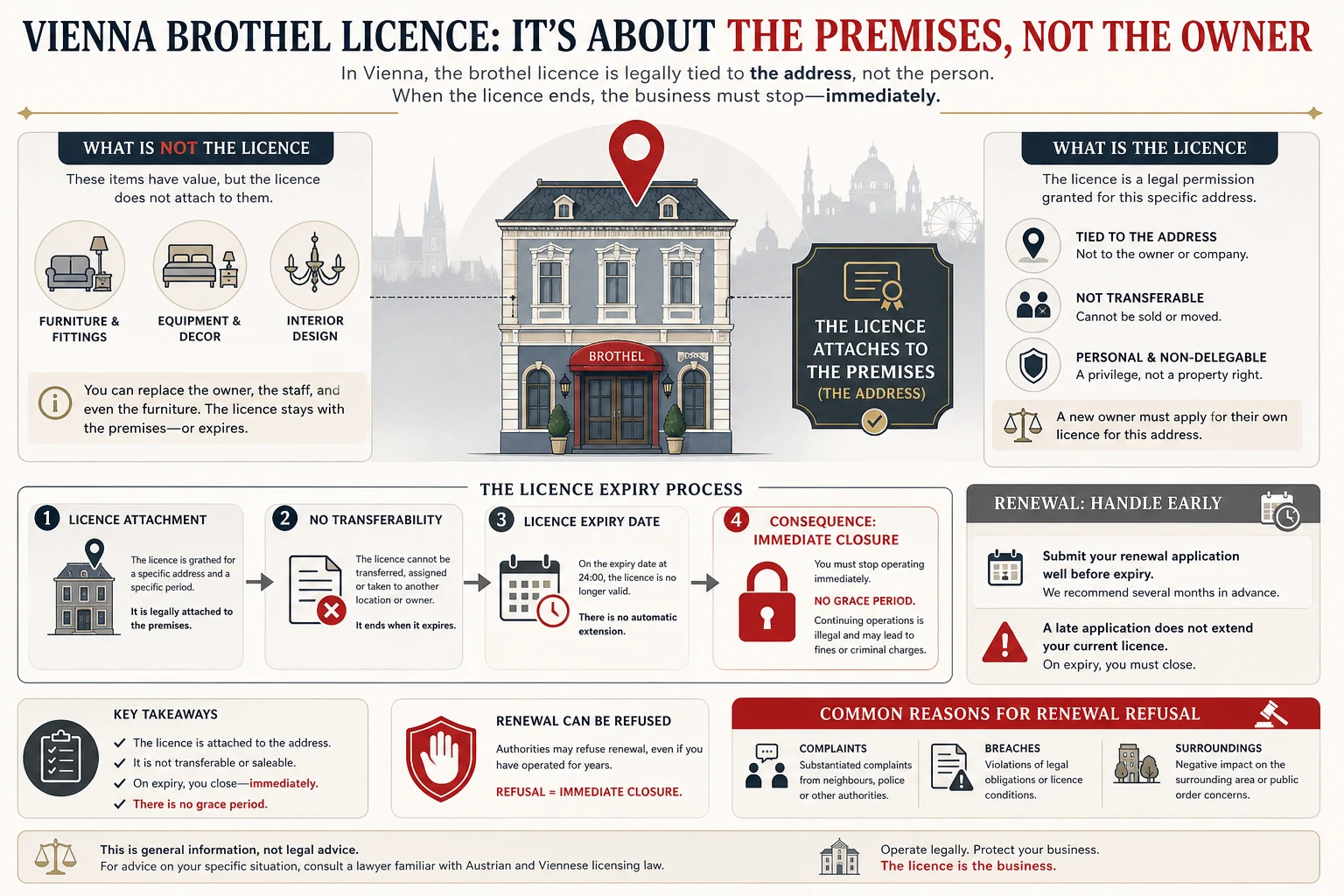
Permission attaches to the premises, not the owner
This is the detail that explains everything else. The authorisation to operate is tied to a specific address and a specific set of conditions about the building and its surroundings. It is not a personal trading certificate that an operator can carry to a different street. Change the address and the process starts again from the beginning, with the new neighbours, the new building and the new district in the assessment.
Which is why nobody in this business treats a licence casually, and why a venue in a good location is worth far more than the sum of what is inside it. The framework is covered in are brothels licensed in Vienna, and the authorities involved in who regulates brothels in Vienna.
What expiry actually means
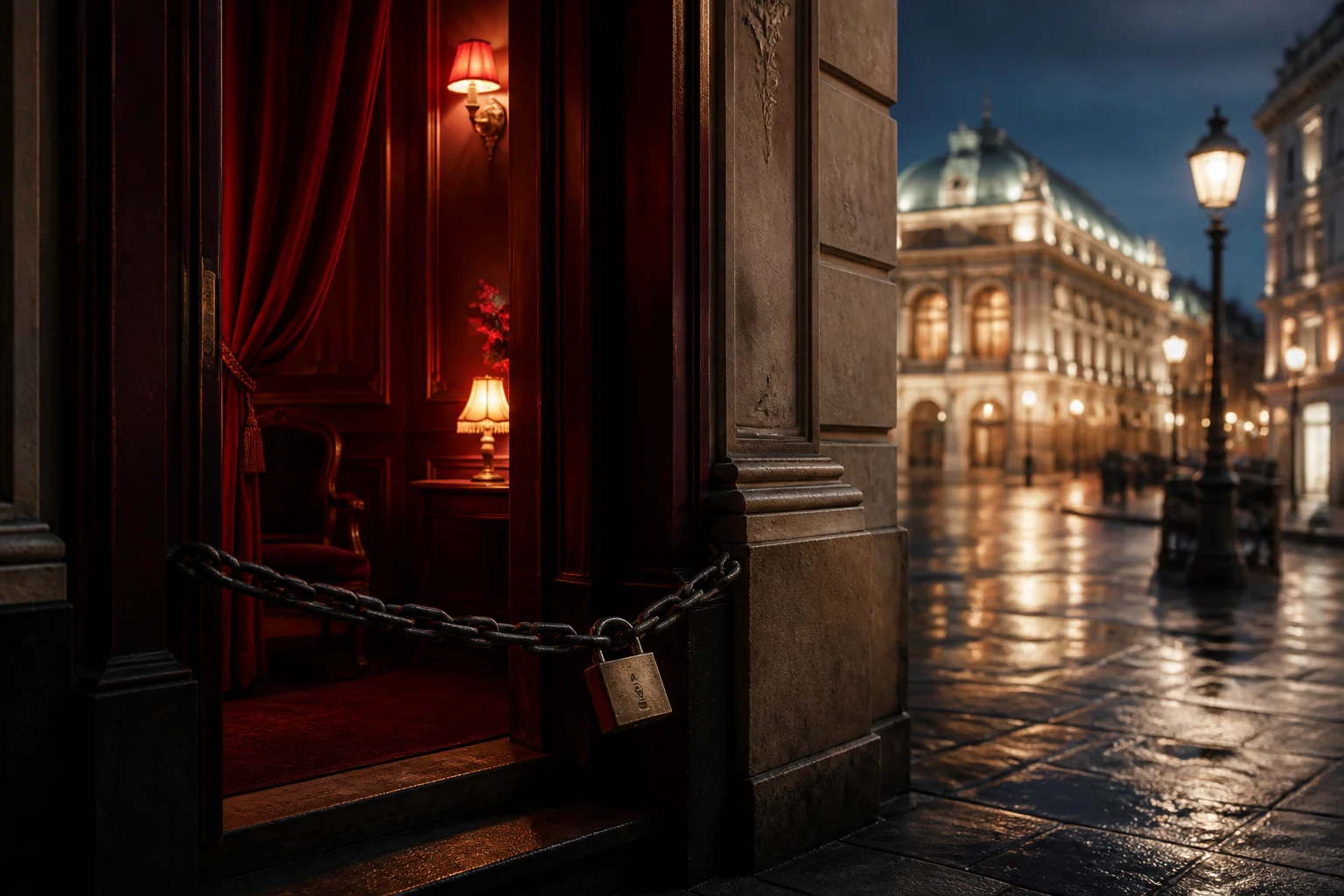
If the authorisation lapses, the lawful basis for operating stops with it. There is no grace period during which a house can keep trading while paperwork catches up. Continuing to open in that window is not a technical breach to be tidied up later; it is operating without permission, and it is the fastest route to a much worse outcome than a late renewal.
Because of that, renewal is handled well in advance rather than at the deadline. Any competent operator has it diarised months ahead, together with the documentation an inspection would ask for. The consolidated text of the Vienna legislation is public and available through the official legal information system for anyone who wants the primary source rather than a summary.
Why a renewal can be refused
Renewal is not a formality, and this is where the accumulated record matters. A history of substantiated neighbour complaints, repeated breaches of the conditions, problems with documentation or workers’ registration, or changes in the surroundings that make the use harder to justify all weigh against it. Nothing here appears suddenly; it builds up over years of small decisions.
That is the real reason well-run houses are so careful about noise at closing time and so rigid about paperwork. It is not caution for its own sake, it is protecting the renewal. The neighbour side of the ledger is the subject of how brothels deal with complaints from neighbours.
What happens to the people inside
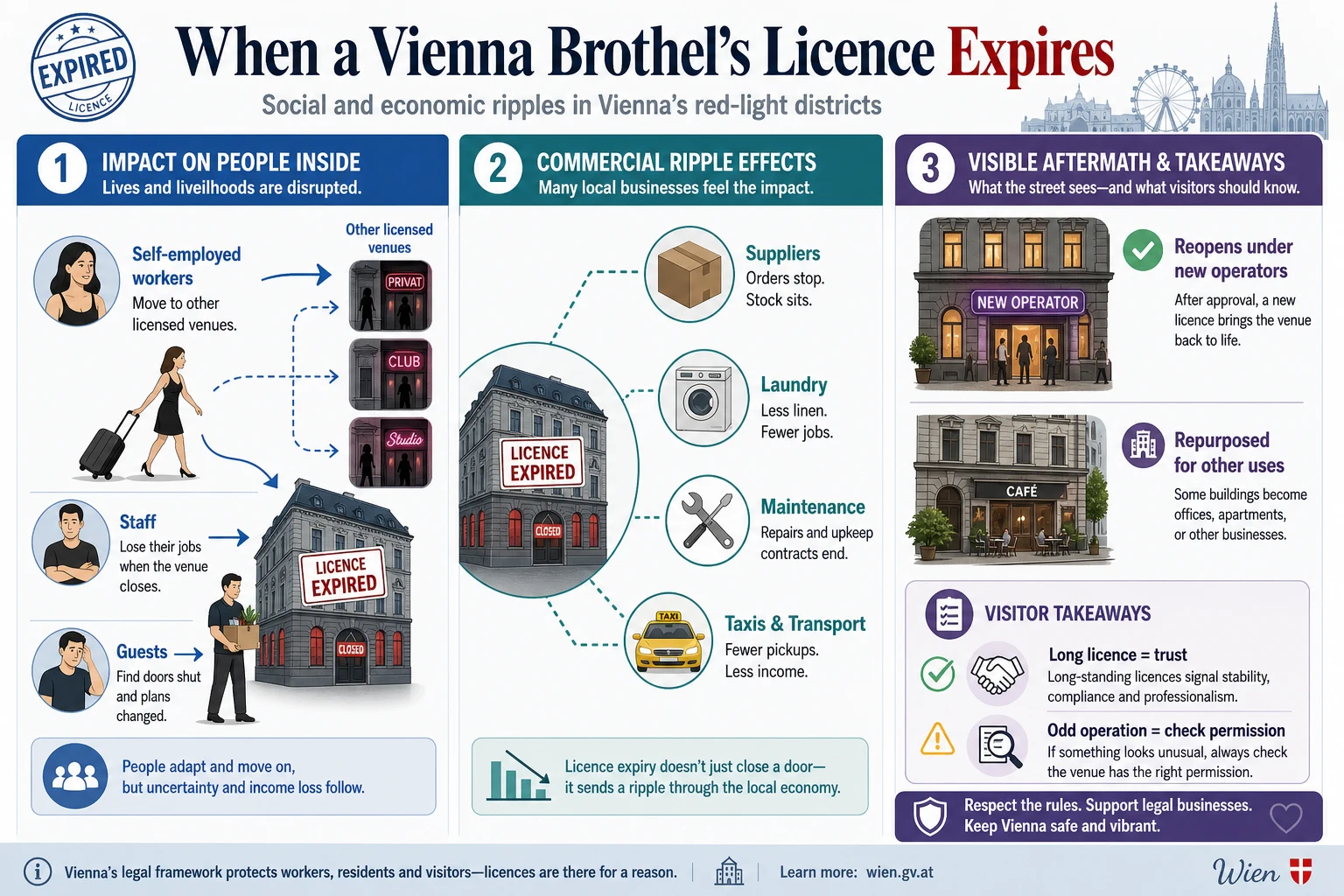
Here the structure of the business matters. The women working in a Vienna house are generally self-employed and personally registered, which means their own registration does not expire with the venue’s. They can move to another licensed house without restarting their own process, which is a genuine protection built into the legal route.
Employed staff, reception, security and housekeeping, are in the ordinary position of people whose workplace closes. And guests simply find the door shut, usually with no explanation posted. The registration point is set out in what rights sex workers have in Austria.
There is also a commercial ripple that outlasts the closure itself. Suppliers lose a customer, the laundry contract ends, the maintenance firm loses a monthly call-out, and the nearby taxi drivers lose a reliable late pick-up point. In a district where several venues sit close together, one closing changes the traffic for the others, sometimes upward and sometimes not, because part of what draws people to a street is the fact that there is more than one option on it. None of this appears in a decision letter, and all of it is felt within a month.
The visible aftermath
Sometimes the venue reopens under a new operator who obtains authorisation for the same premises, and to a passer-by very little seems to have changed apart from the name. Sometimes the use ends entirely and the building becomes something else, which is how districts gradually change character. And sometimes a brand survives while the address does not, which is how a well-known name ends up somewhere unexpected.
This is the slow mechanism behind the redevelopment of former red-light streets, including the changes documented in the ex red-light district at Westbahnhof. The wider legal picture for visitors is in is prostitution legal in Vienna.
What a visitor should take from this
Two things. First, a venue that has held the same licence at the same address for many years is telling you something real about how it operates, because that record is only achievable by staying inside the conditions for a long time. Second, if a place seems to be operating in an odd or improvised way, the questions worth asking are about permission rather than about price.
Longevity is a signal that is hard to fake and easy to check, and it belongs alongside the other markers in how to spot a professional brothel.
In summary
Authorisation is attached to the premises, not to the person, so it cannot simply be moved down the street. When it lapses, the lawful basis for opening ends immediately, with no grace period, which is why renewal is handled months early. Refusal is driven by the accumulated record rather than by a single incident, and that is what makes closing-time noise and clean paperwork worth the effort. Registered workers keep their own status and can move on. And for a visitor, a long unbroken licence at one address remains one of the most reliable quality signals there is.