Vienna has a legal, regulated sex industry, but not every discreet-looking studio or apartment offering sexual services belongs to it. For visitors, the difference is more than a matter of appearance. A licensed brothel should operate within a recognisable framework of registration, health requirements, house rules and accountable management.
Unlicensed premises can be difficult to assess from an advert alone. The safest approach is to look for practical signs of a properly established house, behave respectfully, and avoid arrangements that are vague about prices, location, boundaries or who is responsible for the premises.

Licensed does not mean luxurious
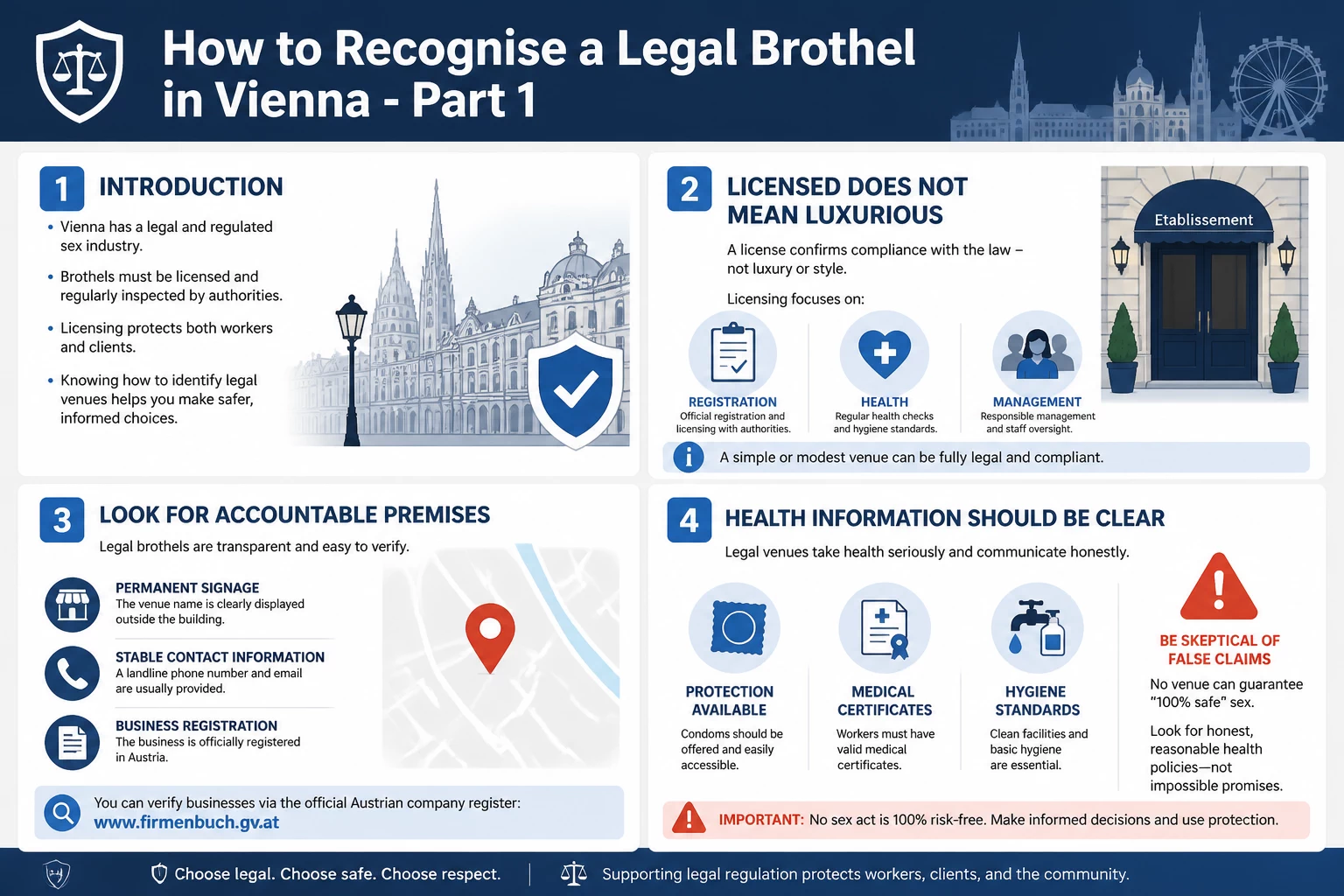
A legal brothel in Vienna is a business operating under the relevant Austrian and Viennese rules. Licensing is not a quality award and does not promise a particular style, price level or atmosphere. It means that the venue is known to the authorities and is expected to meet legal obligations covering the premises and its operation. This explanation of whether brothels are licensed in Vienna is a useful introduction to the distinction between a regulated venue and an informal arrangement.
That framework matters because responsibility is visible. A legitimate house normally has a named operator, staff or management at the door, and an established way of handling payments, complaints and safety concerns. It may be modest, busy or highly polished. The decor tells you little by itself. A registration trail and clear management structure tell you much more.
Look for accountable premises
Before entering, look at how the venue presents itself. A permanent commercial location, a consistent name and contact details, and information that does not change from one advert to the next are reassuring signs. A legal house should be able to identify itself as a business rather than hiding behind a succession of disposable phone numbers, anonymous messages or last-minute meeting points.
Location is useful context, though it is not proof. Licensed venues tend to operate from premises arranged for that purpose, while unlicensed studios and apartments may be advertised as temporary rooms, private visits or appointments at an address disclosed only after payment or contact. An apartment is not automatically illegal, and a smart-looking club is not automatically licensed. The question is whether the operator and premises are properly registered.
Health information should be clear
Health arrangements are another practical distinction. Sex workers in regulated settings may have obligations concerning medical examinations and certificates, and a professional venue should be able to explain its health policy without making theatrical promises. Sensible information focuses on safer sex, consent, hygiene and the limits of what the venue can guarantee.
Visitors should be wary of claims such as “completely safe” or “no protection needed”. Those are not signs of good regulation. They are reasons to leave. A useful overview of health checks in Austrian brothels explains why certificates and medical procedures should not be confused with a guarantee against every infection. Condoms, honest communication and respect for boundaries remain essential.
House rules reveal the culture
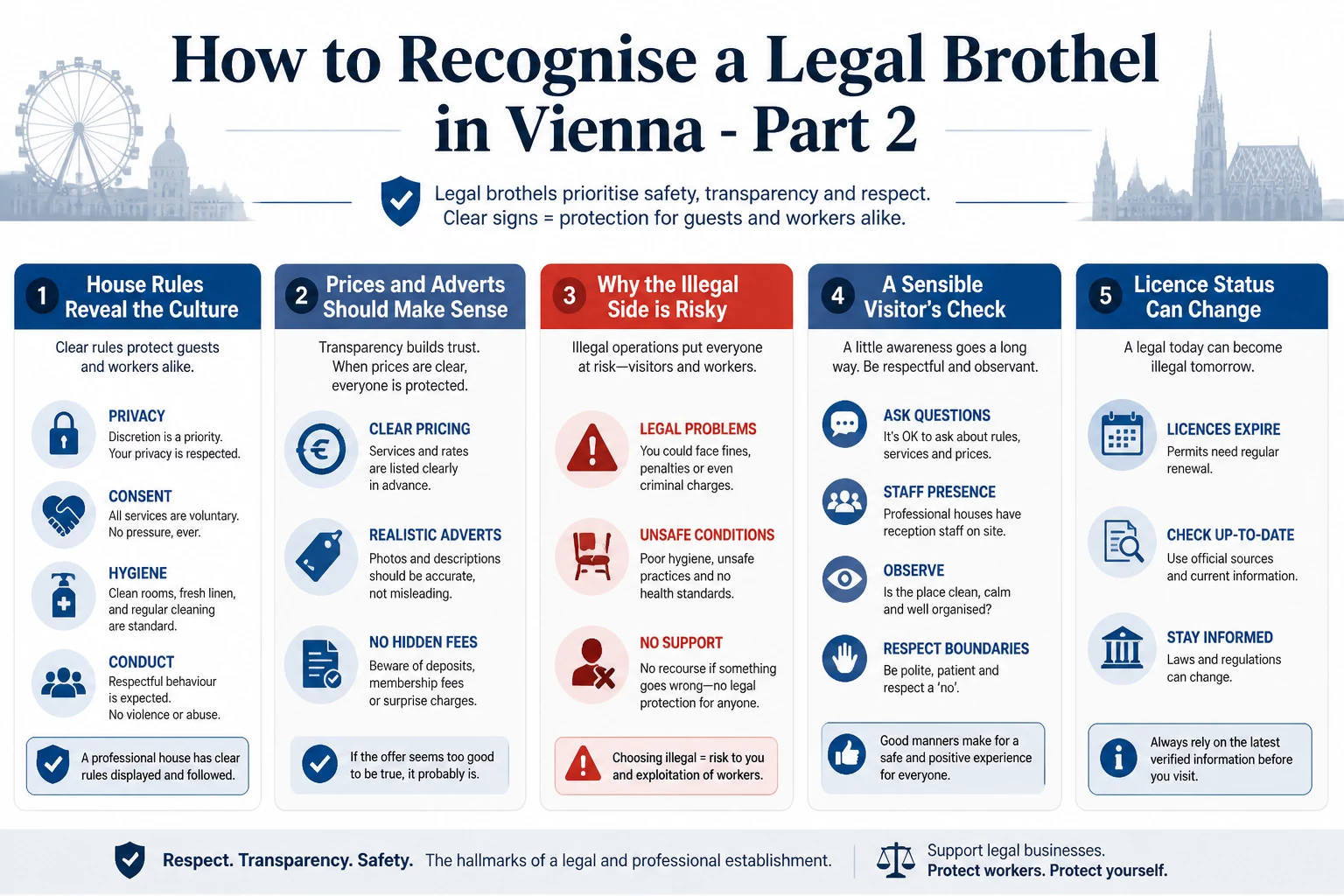
Clear house rules are one of the strongest everyday clues. They should cover conduct, privacy, photography, payment, consent, hygiene and the treatment of the women. A responsible venue makes it clear that guests must follow instructions from staff and sex workers, and that services are agreed rather than assumed.
Rules are not merely decoration. They give staff a basis for stopping harassment, refusing unsafe requests and removing a difficult guest. The practical reasons are set out in this guide to why brothels have house rules. If a place has no visible standards, laughs off questions about consent or encourages visitors to pressure the ladies, treat that as a serious warning.
Prices and adverts should make sense
Transparent pricing is another mark of a properly run business. Charges should be explained before anything begins, including any entrance fee, room charge, drinks or time-based arrangement. The sex worker should be free to agree the details directly, and a visitor should never assume that an advertised entry price includes a private service.
Different prices for different times, rooms or arrangements are not automatically suspicious. The useful test is whether the information is available in advance and whether the final amount matches what was agreed. A venue such as Maxim Wien presents itself as a high-class licensed club, showing how an established house can communicate its identity openly. By contrast, adverts that promise everything, demand a deposit before giving basic information, or change the price at the door deserve caution.
Why the illegal side is risky
Unlicensed studios and apartments create risks for visitors because there may be no dependable operator, complaints process or clear division of responsibility. The address can disappear, the advertised person may not be present, and a guest may face unexpected charges or pressure. Police action, disputes between organisers and workers, and sudden closure can also leave everyone involved without the protections associated with a regulated business.
The workers carry the heavier burden. An underground arrangement may mean poorer control over who enters, less support when a client becomes aggressive, and greater exposure to exploitative intermediaries. It can also make access to advice, healthcare and legal assistance harder. Reporting on the sector regularly connects high operating costs and restrictive conditions with movement into private apartments, as discussed in this account of sex workers being pushed into private apartments. The issue is not that every private setting is abusive, but that hidden arrangements reduce accountability.
A sensible visitor’s check
Before visiting, read the venue’s own information, look for a stable identity and ask straightforward questions about entry, prices, house rules and safer sex. At the premises, notice whether staff are present, whether the women can speak freely, and whether the atmosphere allows a polite refusal. Keep your own boundaries clear, do not photograph people, and leave if the arrangements become confusing or coercive.
A licence is also not a permanent badge that can be assumed indefinitely. Businesses can change operators, premises can change status and permissions can expire. This account of what happens when a Vienna brothel’s licence expires illustrates why current status matters rather than relying only on an old directory entry or familiar name.
Licences, registrations, health certificates and operating details are not always displayed in the same way, and details vary by house, so the venue’s status should be checked through reliable information before travelling. A legal brothel will normally withstand ordinary questions. Evasion, secrecy, pressure and improvised payment demands are the practical signals to take seriously.