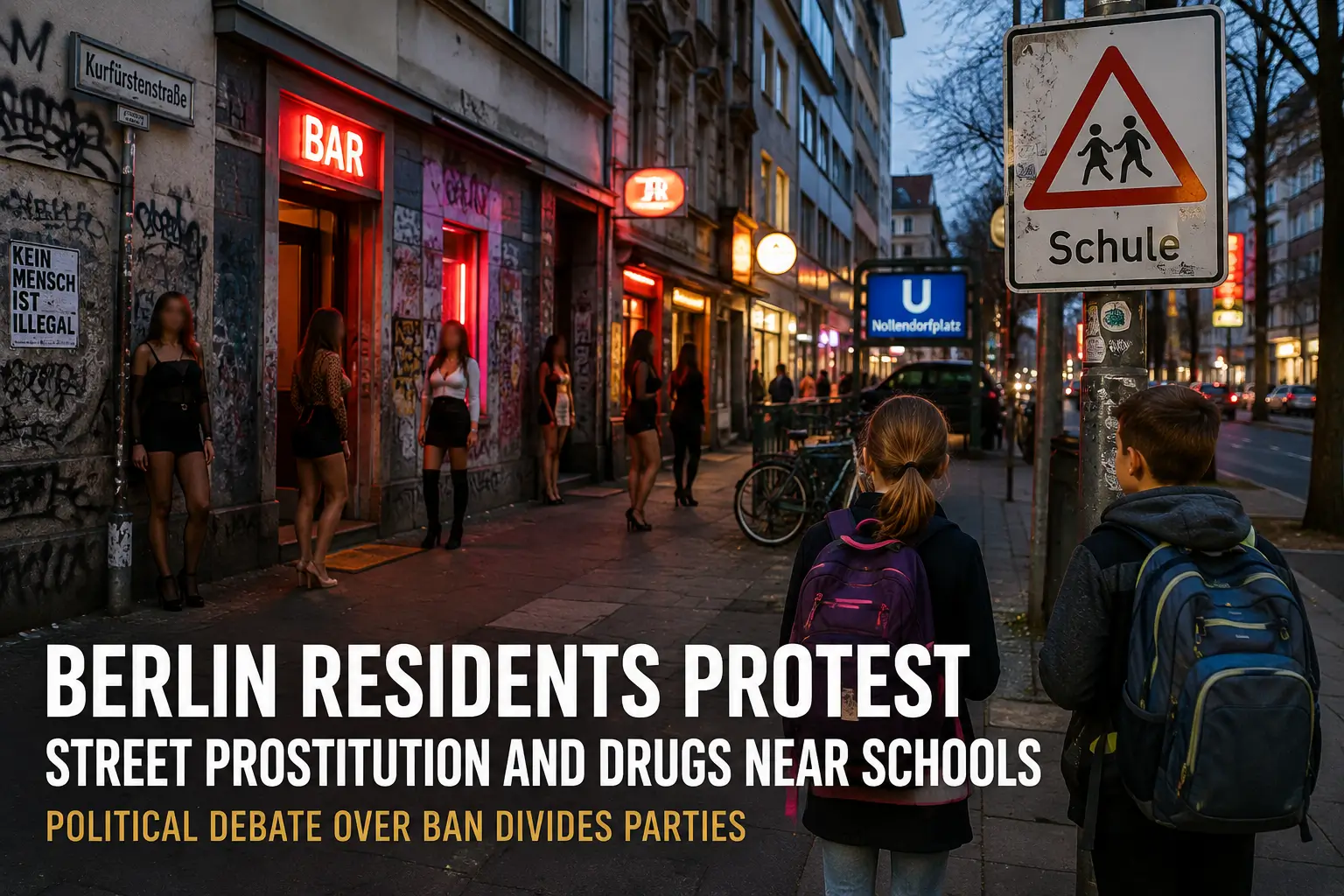
Residents in Berlin are increasing pressure on city authorities over street prostitution, drug use and violence around Kurfürstenstraße. The area has been associated with street prostitution for decades, but local residents say the situation has become especially difficult because schools, kindergartens and other facilities used by children are located nearby.
The debate has now reached Berlin politics. While the CDU is calling for a ban on street prostitution, other political parties argue that prohibition could simply move sex workers and related problems to other neighborhoods.

Residents Call for Restricted Zones
People living around Kurfürstenstraße have organized protests demanding stronger action from the authorities. Their concerns include prostitution close to schools and kindergartens, public drug consumption, drug dealing and violence in the neighborhood.
One of the proposals is to introduce restricted zones around sensitive locations such as schools, kindergartens and facilities for elderly people. Residents want these areas to be kept free from street prostitution and are also demanding stronger measures against open drug dealing and consumption.
Reports that minors have also been involved in street prostitution in the area have increased concerns about exploitation and the safety of young people.
CDU Wants Street Prostitution Banned
Berlin’s CDU wants to go further and has proposed a broader ban on street prostitution. The party wants restrictions to begin in the Kurfürstenstraße and Nollendorfplatz areas before potentially being introduced across the city.
CDU politicians argue that the current situation is unacceptable for both residents and sex workers. They say women are sometimes working under extremely difficult conditions while children and teenagers are exposed to prostitution, drugs and violence in public spaces.
The party also opposes using public money to create special infrastructure where street prostitution could continue under controlled conditions. Instead, it wants authorities to take stronger action against the activity itself.
SPD Warns That Prostitution Would Simply Move Elsewhere
The proposal has received criticism from the SPD. Politicians opposing the ban argue that removing prostitution from one street does not mean prostitution will disappear.
Instead, sex workers could move to less visible locations, making them harder for social workers and support organizations to reach. Critics fear this could actually make working conditions more dangerous for some women.
They also argue that poverty, violence, addiction and human trafficking cannot be solved simply by banning street prostitution. Women in difficult situations need access to social services and realistic alternatives if they want to leave prostitution.
Greens and Left Party Also Oppose a General Ban
Politicians from the Greens and the Left Party have expressed similar concerns. They argue that policing alone cannot solve the complex social problems surrounding the Kurfürstenstraße area.
Homelessness, mental health problems, drug addiction and poverty are all connected to the situation. Moving sex workers away from one neighborhood could therefore result in the same problems appearing in nearby streets or parks.
Supporters of this approach want authorities to focus more strongly on social services, protection against violence and measures against exploitation rather than introducing a general prohibition.
Berlin Authorities Examine Possible Measures
Berlin authorities are considering what measures could legally and practically be introduced. Any major restriction would require cooperation between several parts of the city administration, including departments responsible for social affairs, health and education.
Officials have also warned that pushing prostitution underground can create additional risks. When sex workers operate in hidden locations, authorities and support organizations may have greater difficulty identifying violence, exploitation or human trafficking.
The political challenge is therefore finding a solution that improves conditions for residents without making vulnerable sex workers less visible and more difficult to protect.
School Was Separated From the Area by a Large Fence
Concerns about children being exposed to prostitution in the Kurfürstenstraße area are not new. Authorities previously took unusual measures to protect a nearby school from activity taking place around the street prostitution zone.
A fence approximately 125 meters long and 1.8 meters high was constructed around the Französisches Gymnasium. The barrier was intended to separate school grounds from activity connected with prostitution in the surrounding area.
Before the fence was installed, students had reportedly encountered prostitution close to the school. Used condoms, syringes and other discarded items had also been found around the school grounds.
Debate Over the Future of Street Prostitution Continues
The dispute highlights the difficulty of regulating street prostitution in a major European city. Residents understandably want clean and safe public spaces, particularly around schools and places used by children.
At the same time, opponents of a ban argue that prostitution will not disappear simply because it is prohibited on particular streets. Berlin must therefore decide whether restrictions can genuinely improve the neighborhood or whether they would mainly move prostitution, drug use and related social problems somewhere else.