Every legal brothel in Vienna runs on paperwork that most guests never see. Before a woman takes her first shift, a small stack of documents has to be in order, and the venue has a direct interest in checking them, because an incomplete file is the venue’s problem as much as the worker’s.
This guide walks through what is normally required, why each item exists, and what a reception desk actually looks at.

Why the paperwork comes before the first shift
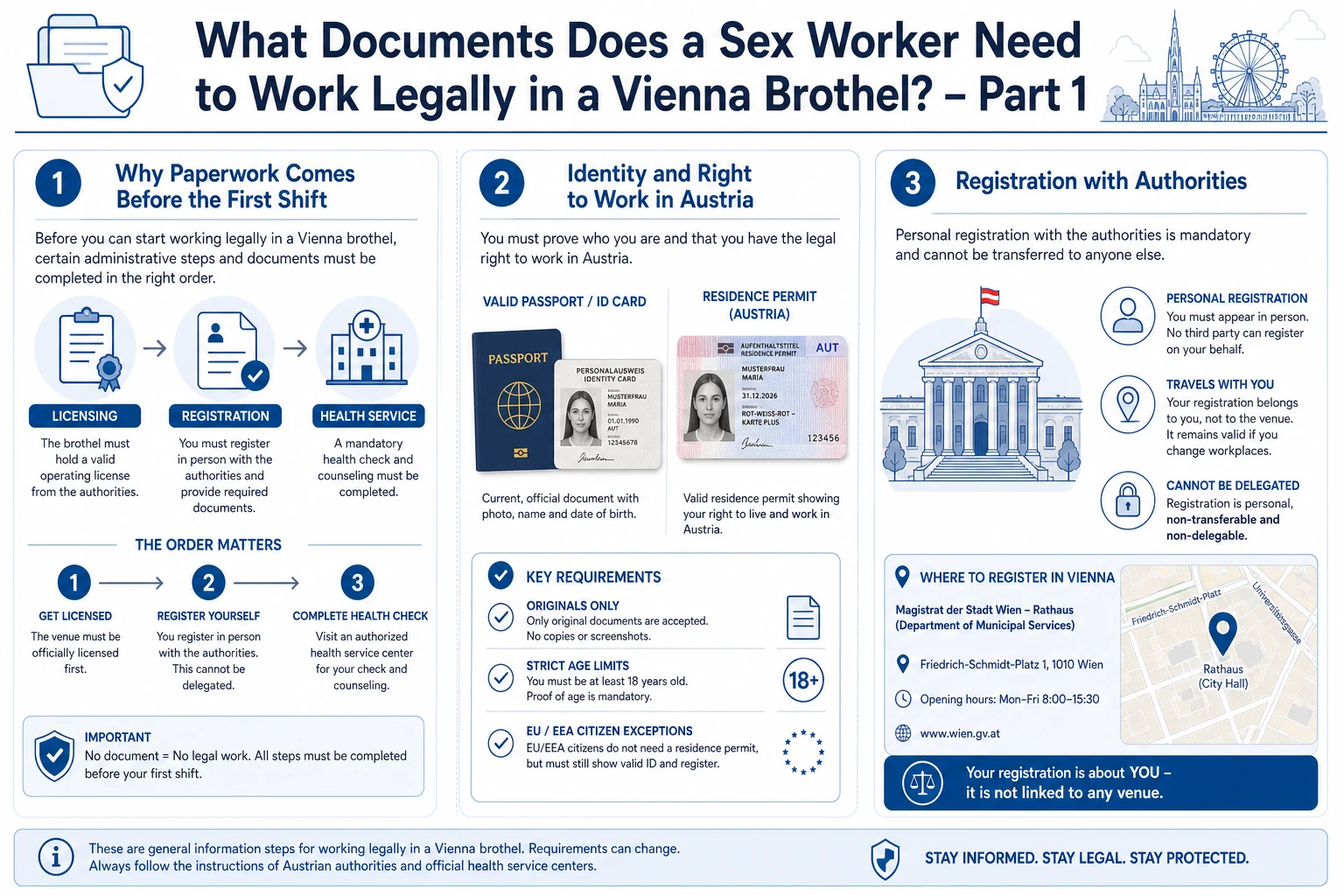
Sex work is legal in Austria when it happens inside the rules, and those rules are administrative rather than mysterious. The city licenses the premises, the authorities register the person, and the health service issues a document confirming regular check-ups. Each of the three sits with a different office, which is why nobody can hand over one single permit that covers everything.
The practical consequence is that the order matters. A venue cannot put someone on the floor and sort the file out afterwards, because an inspection can arrive on any evening. If you want the background on who carries out those inspections, we covered it separately in who regulates brothels in Vienna.
Identity and the right to work in Austria
The first document is the simplest: a valid passport or national identity card. For citizens of EU and EEA countries, this is usually the only immigration-related paper needed, because freedom of movement covers the right to take up self-employed work. For everyone else, a residence title that permits self-employment has to be in place first, and that is the point where most files stall.
A venue will not accept a photograph of a document or a copy on a phone. It wants the original in hand, because that is what an inspector will ask for. This also explains the strictness around age: there is a hard legal floor, and no venue with a licence to protect will bend on it. The details are in age restrictions for Vienna brothels.
Registration with the authorities
Working legally means being registered as a sex worker with the responsible authority, not simply being employed by a house. The registration is personal. It travels with the worker, not with the address, which means someone can change venues without starting the process again, and it also means a venue cannot register anybody on their behalf.
Registration is also what separates the legal side of the trade from the illegal one, and the gap between the two is wide in practice: rights, recourse and safety all sit on the legal side. The city’s own portal is the starting point for current forms and office hours, and it is worth using the official route rather than second-hand advice, because the administrative detail does change. A general overview of the legal framework is available on legal sex work in Austria, and the municipal services are listed at the City of Vienna.
The health check document
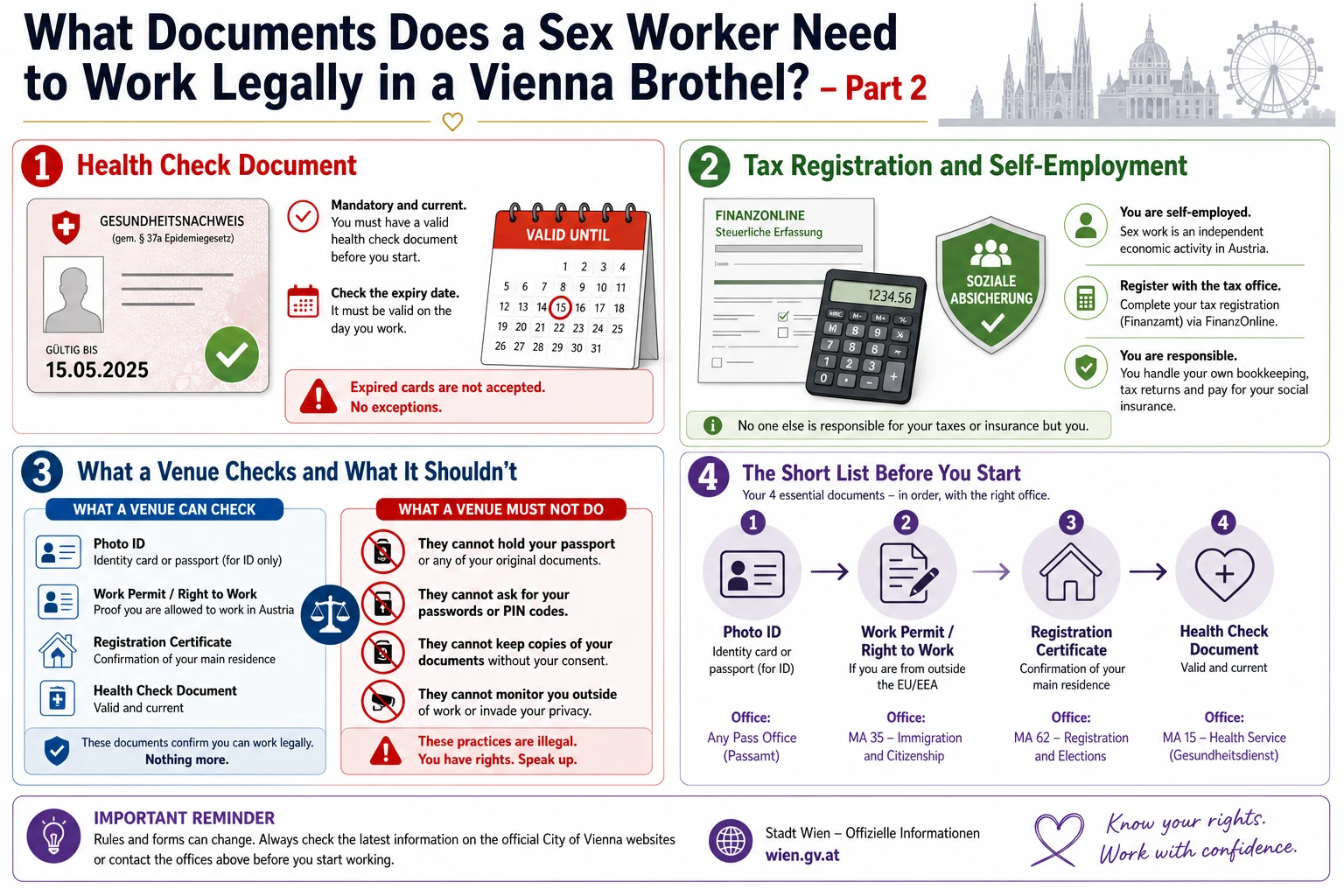
The document guests hear about most often is the health check card. It confirms that the holder attends the screening appointments set by the health authority, and it has to be current: an expired card is treated exactly like a missing one. The interval and the tests included are decided by the health service, not by the venue, so a house cannot shorten or extend them to suit a busy weekend.
Reception keeps track of expiry dates, because a lapsed card means somebody does not work that night. It is the least negotiable item on the list, and it is the reason hygiene standards in Austrian houses are more than marketing language. We wrote about what the screening involves in health checks in Austrian brothels.
Tax registration and being self-employed
Sex workers in Austria are normally self-employed rather than salaried staff, and that has a paperwork tail of its own: a tax number, bookkeeping good enough to survive a question later, and social insurance arrangements that the worker sets up personally. None of this is handled by the house, even when the house rents the room and takes the entry fee.
This is the part newcomers most often underestimate, because there is no monthly payslip to make it visible. It is worth reading up before the first shift rather than in the second year, and we set out the basics in how sex workers pay taxes in Austria.
What a venue checks, and what it has no business asking
A professional house checks four things: identity, the right to work, registration and a current health card. It keeps what it needs for an inspection and nothing beyond that. What it should not be doing is holding original documents as leverage, demanding passwords, or keeping a passport in a safe “until the end of the season”. Those are control tactics, not compliance, and they are a signal to leave rather than negotiate.
Knowing where the line sits is the most useful thing a newcomer can carry into a first conversation with a manager. The protections that exist are real and they are enforceable, which is the whole point of the legal route. We summarised them in what rights sex workers have in Austria.
The short list, before you start
Four items, three offices, one order of operations. Bring a valid passport or ID card, make sure your right to self-employed work in Austria is documented, complete your personal registration as a sex worker, and keep the health check card current. Add the tax and social insurance setup, and the file is complete. Everything a legal venue asks for is on that list, and anything beyond it deserves a question rather than a signature. The forms change from time to time, so check the current requirements with the city before you rely on what a colleague told you last year.