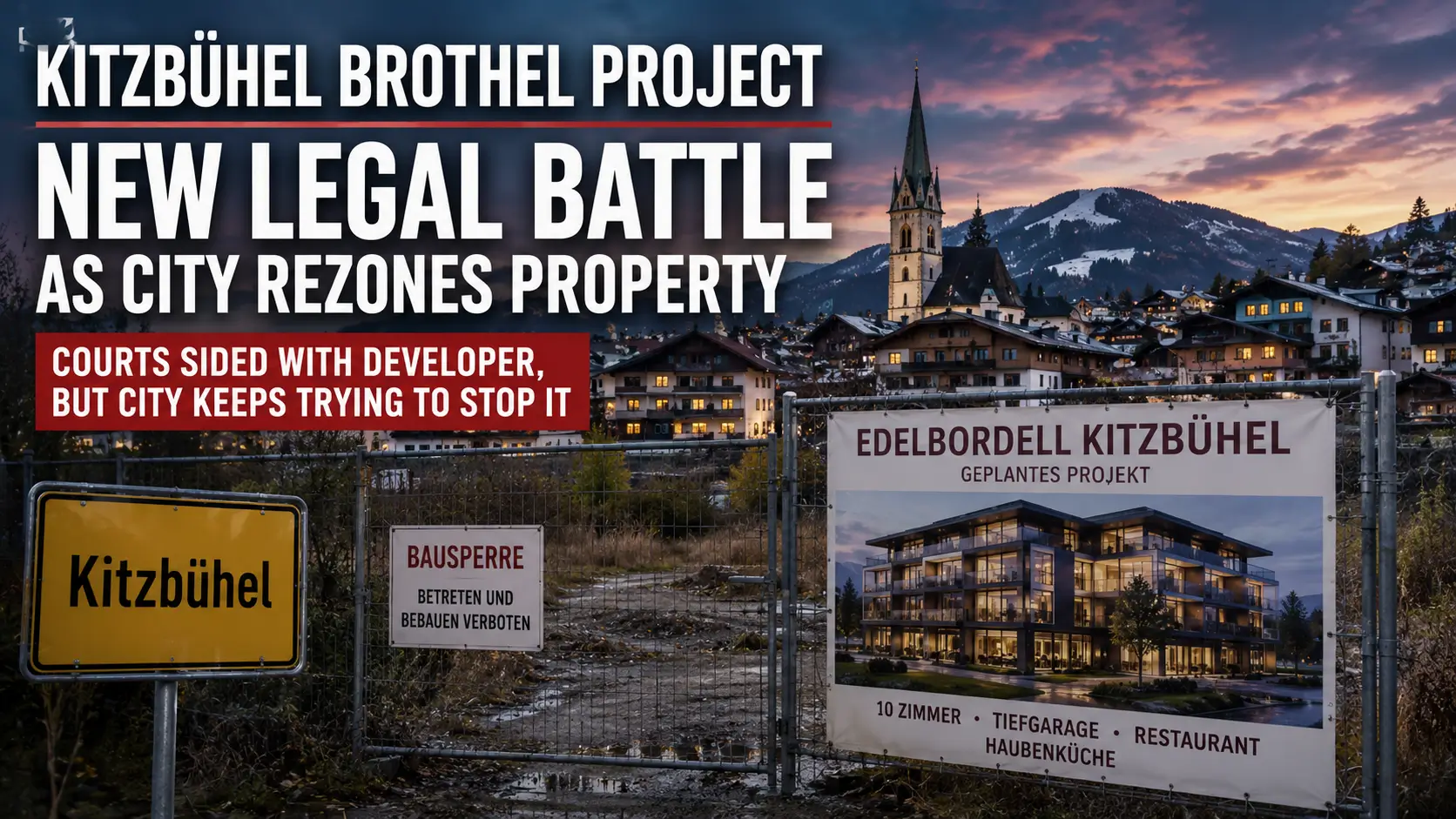
A long-running dispute over plans for a luxury brothel in Kitzbühel has entered another round after the city rezoned the property where the establishment is supposed to be built. The controversial project has already been through several court proceedings, with previous decisions supporting the developer’s position.
Despite those decisions, the city has continued taking steps that could prevent the project from moving forward. The company behind the planned establishment is now threatening further legal action, including possible compensation claims and formal complaints.

Brothel Project Has Been Discussed for More Than 20 Years
According to ORF Tirol, the dispute concerns a roughly 800-square-metre property on St. Johanner Straße in Kitzbühel. The site has occupied local politicians, authorities and developers for more than two decades.
A company previously obtained commercial zoning for the property and planned to establish a brothel there. Construction work was later stopped by the district authority because of violations of building regulations, but the idea of developing a brothel on the property did not disappear.
The property and its zoning eventually passed to Gewerbe Projekt Kitz GmbH. Managing director Wolfgang Saringer has continued pursuing the project and still intends to build the establishment.
At the end of 2023, the company applied to Kitzbühel for the necessary building permit. The city rejected the application, arguing that a brothel was not permitted under the property’s classification as a commercial area.
Courts Sided With the Developer
The company challenged the city’s decision before the Tyrolean Regional Administrative Court and won. The court accepted the argument that a brothel could be considered an entertainment establishment and was therefore compatible with the property’s existing commercial zoning.
Kitzbühel did not accept that outcome and brought the matter before Austria’s Administrative Court. However, the city was unsuccessful there as well, with the court reportedly describing the legal situation as clear and rejecting the appeal.
These decisions strengthened the developer’s argument that the existing zoning allowed the proposed use. The company subsequently submitted another application for a building permit and says it also incorporated changes to the project that had been requested by the city.
Ten Rooms, Underground Parking and a Restaurant
The proposed establishment would be considerably more ambitious than a small local brothel. Current plans reportedly include ten rooms, an underground garage and a restaurant with a high-level chef.
The concept appears to be aimed at the luxury end of the market, which is perhaps unsurprising given the proposed location. Kitzbühel is internationally known as an upscale Alpine destination attracting wealthy tourists, businesspeople and visitors throughout the year.
However, the city continued opposing the development after losing the previous court cases. A temporary construction ban was introduced, with possible conflicts between commercial and residential uses given as one of the reasons.
Residential buildings can be found in the surrounding area, and a Kingdom Hall of Jehovah’s Witnesses is also located nearby. The developer’s legal representatives dispute that these circumstances create the kind of conflict claimed by the city.
Developer Says Conflicts Were “Artificially Constructed”
Attorney Simon Gleirscher, representing the developer, argued that the alleged conflicts were essentially being created as a way of stopping the project. According to the developer’s position, the property was surrounded by sites classified as commercial and industrial areas.
The dispute has now taken another significant turn because Kitzbühel’s municipal council has approved changes to the zoning of numerous properties in the affected area. Much of the land previously designated for commercial or industrial purposes is being converted into mixed-use areas allowing restricted residential use.
Importantly, the property intended for the brothel is included in the rezoning. According to an ORF inspection of the area, some owners of affected properties apparently did not even know beforehand that their land was being rezoned.
Kitzbühel Mayor Klaus Winkler did not give ORF an interview regarding the dispute. The city instead referred to the fact that proceedings concerning the project are still ongoing.
Another Legal Fight Is Now Likely
The company behind the project has reacted strongly to the latest development and is preparing for another potential legal battle. Its central complaint is that the property is being rezoned while a decision on the latest building application has not yet been made.
The developer’s lawyer described the measures as an attempt specifically connected to this particular project. From the company’s perspective, the city is trying to achieve through a construction ban and rezoning what it failed to achieve through its earlier interpretation of the existing planning rules.
If the State of Tyrol approves the zoning changes, the developer has promised to use all available legal remedies. Its representatives have also raised the possibility of compensation claims and formal complaints, meaning the financial consequences of the dispute could eventually extend beyond the brothel project itself.
Prostitution Rules in Tyrol Have Changed
The dispute is also taking place against a changing legal background for prostitution in Tyrol. In the past, opening a brothel required demonstrating that there was a local need for such an establishment, but this requirement was removed through an amendment to the Tyrolean State Police Act in 2021.
Separately from the planned Kitzbühel establishment, police say they are monitoring illegal prostitution in the district. Deputy district police commander Josef Feyersinger told ORF that relevant advertisements can be found online and that their number in and around Kitzbühel has recently increased slightly.
Specialised officers are responsible for carrying out checks connected with illegal prostitution. The existence of illegal activity is therefore another interesting element of a debate about whether a properly regulated and licensed establishment should be permitted to open.
Our View: A Legal Business Needs Predictable Rules
Nobody should expect a brothel to be exempt from building regulations, licensing requirements, health rules or other laws simply because prostitution itself is legal. A legal brothel should follow the regulations applying to it, just as restaurants, hotels, nightclubs and other regulated businesses have to follow the rules applying to them.
But the opposite principle matters too: businesses need to know what the rules actually are. If an applicant follows the established procedure, challenges a rejection in court and receives favourable decisions, authorities should have very strong and transparent reasons for subsequently changing the circumstances under which that application is considered.
That is what makes the Kitzbühel case particularly interesting. The developer challenged the city’s interpretation of the commercial zoning and won before the Regional Administrative Court, while the city’s subsequent attempt before the Administrative Court was also unsuccessful.
A construction ban followed, and now the affected property itself is being rezoned together with other land in the area. Whether these measures are legally justified will ultimately be a matter for the relevant authorities and potentially the courts, but it is understandable why the developer considers the sequence of events questionable.
Being Against Prostitution Does Not Make It Illegal
There will always be people who oppose brothels for moral, religious or personal reasons, and they are entitled to hold those opinions. However, personal opposition to prostitution is different from determining whether a specific business complies with Austrian and Tyrolean law.
Austria has chosen a regulated model under which prostitution and licensed brothels can operate subject to legal requirements. If authorities want sex businesses to operate within that regulated system rather than outside it, legitimate operators also need a realistic path toward obtaining the permissions required to operate legally.
The situation is particularly noteworthy because police are simultaneously reporting signs of illegal prostitution in the region. Making it extremely difficult for regulated establishments to open does not automatically make demand for sexual services disappear, and this is something policymakers should consider when deciding how the legal market should function.
The proposed luxury brothel in Kitzbühel may eventually open, or another legal decision may prevent it from doing so. What is already certain is that after more than two decades of disputes surrounding this approximately 800-square-metre property, the battle is nowhere near finished.