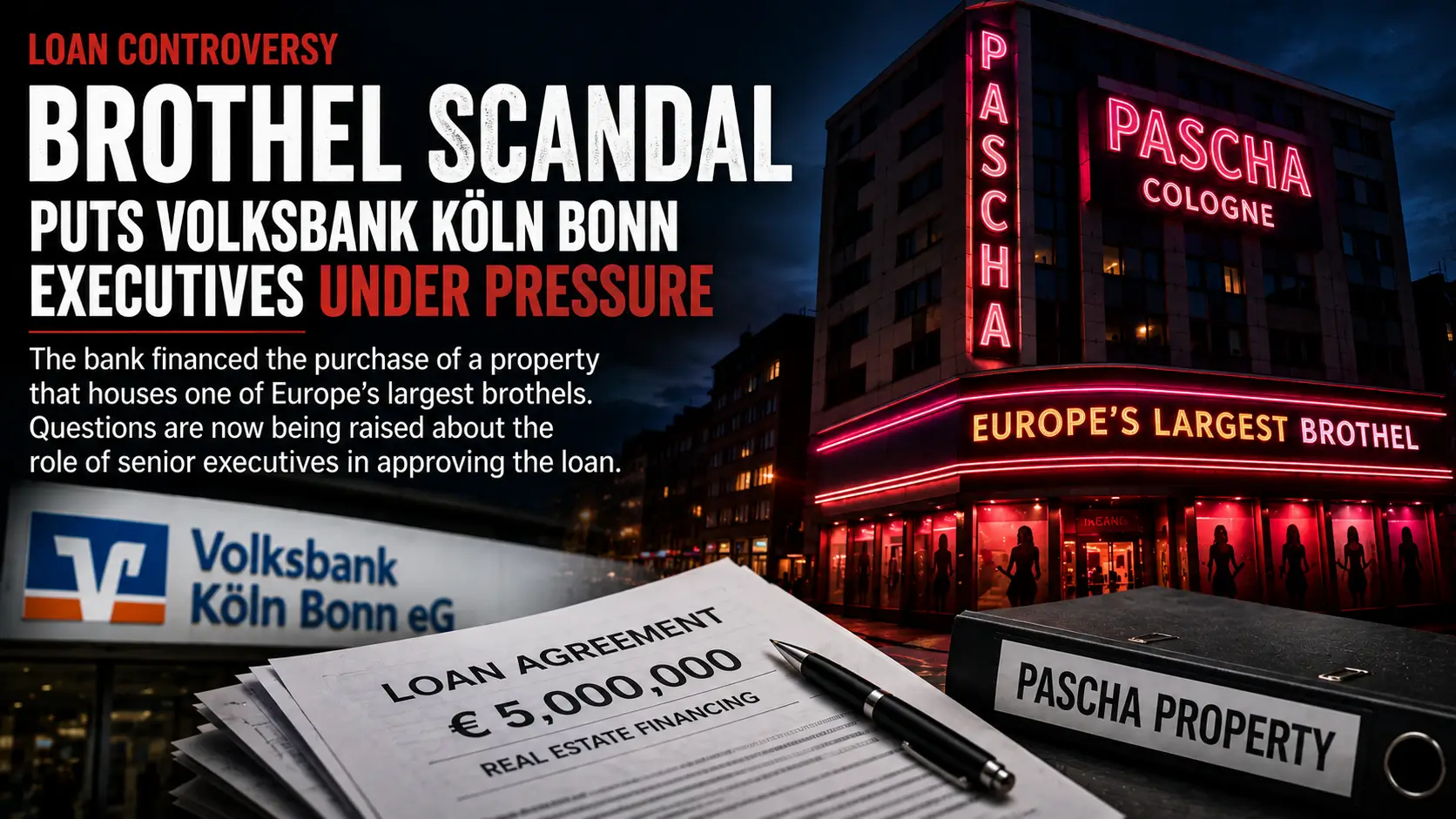
Volksbank Köln Bonn is facing questions over a €5 million loan connected to the purchase of the building that houses Pascha, one of Germany’s best-known and largest brothels. According to German business newspaper Handelsblatt, internal documents and communications have raised questions about how the financing was approved.
The property in Cologne was purchased in spring 2021 by an investor described as Chinese. Volksbank Köln Bonn reportedly financed part of the purchase price with the €5 million loan, and attention is now focusing on the role senior bank officials may have played in the process.
€5 Million Loan for Cologne’s Pascha Building
The property is located on Hornstraße in Cologne and is widely known because it houses Pascha, a large prostitution establishment operating from the multi-storey building. The sale of such a prominent commercial property required significant financing, part of which reportedly came from Volksbank Köln Bonn.
The controversy is not primarily about the fact that a bank financed a property containing a brothel. Instead, questions concern the circumstances surrounding the approval of the loan and the people who may have helped arrange it.
Internal Documents Raise Questions About the Loan
WDR first reported details about the case, citing internal documents, emails and intercepted telephone conversations. According to the reports, this material suggests that the €5 million loan may have been arranged under questionable circumstances.
A lawyer identified as Claus B. is alleged to have used his connections with a member of the Volksbank management board to help with the financing. The lawyer is also accused in a separate investigation involving an alleged immigration-smuggling network.
The lawyer’s defence attorney did not comment on the allegations when contacted about the case. As the relevant investigations remain ongoing, the accusations have not been established as facts by a final court judgment.
Connection to Major Immigration Investigation
The Düsseldorf Public Prosecutor’s Office is investigating members of an alleged organization suspected of helping wealthy foreigners obtain German residence permits in exchange for large payments. According to investigators, many of the people involved were reportedly from China.
Claus B. is among the individuals accused in connection with that investigation. The new reporting about the Pascha financing has now drawn attention to whether his personal connections may also have played a role in obtaining the multimillion-euro bank loan.
The allegations therefore extend beyond the brothel property itself. Investigators and journalists are examining a broader network of business relationships, financial transactions and alleged influence.
Bank Executives Face Questions
The involvement of a member of Volksbank Köln Bonn’s management board is particularly sensitive for the cooperative bank. Banks are expected to follow established procedures when evaluating borrowers, assessing risks and approving large commercial loans.
The available reporting raises questions about whether personal relationships may have influenced the financing decision. However, the existence of questions surrounding the loan does not by itself establish criminal wrongdoing by the bank or its executives.
Further investigation will be required to establish exactly how the loan was approved and whether normal internal procedures were followed. The reported internal communications are likely to play an important role in determining what happened.
Pascha Is One of Germany’s Most Famous Brothels
The building involved in the controversy is particularly recognizable because of its connection with Pascha. The Cologne establishment has long been one of the most prominent names in Germany’s legal prostitution industry.
Its size and unusual multi-storey location have made the property well known beyond Cologne. This means that a multimillion-euro transaction involving the building naturally attracts considerably more public attention than the sale of an ordinary commercial property.
The current controversy, however, concerns the financing of the real estate transaction rather than allegations about the everyday operation of the brothel itself. The distinction is important because the investigation described in the reports focuses on the loan and its possible connections to individuals involved in a separate criminal case.
Controversy Comes at Difficult Time for Cooperative Banks
The affair comes at an uncomfortable moment for Germany’s cooperative banking sector. According to Handelsblatt, Volksbanken and Raiffeisenbanken have experienced a number of financial difficulties and problematic cases during the past two years.
Several institutions have required assistance from the sector’s protection fund. Against that background, questions surrounding a €5 million commercial loan are likely to receive particularly close attention from within the cooperative banking system.
For Volksbank Köln Bonn, the central issue will be explaining how the financing decision was made and what role individual executives played. The continuing investigations may eventually provide a clearer picture of whether the Pascha property loan was simply an unusual commercial transaction or part of a much larger problem.