Every venue that has been open more than a few years has a hierarchy of rooms, whether it admits it or not. One is tired, one is the one everybody asks for, and two are somewhere in between. Refurbishment costs money and takes a room out of service while it happens, so the order is a real decision with real consequences. This is how that decision actually gets made.
Revenue per room is the first number
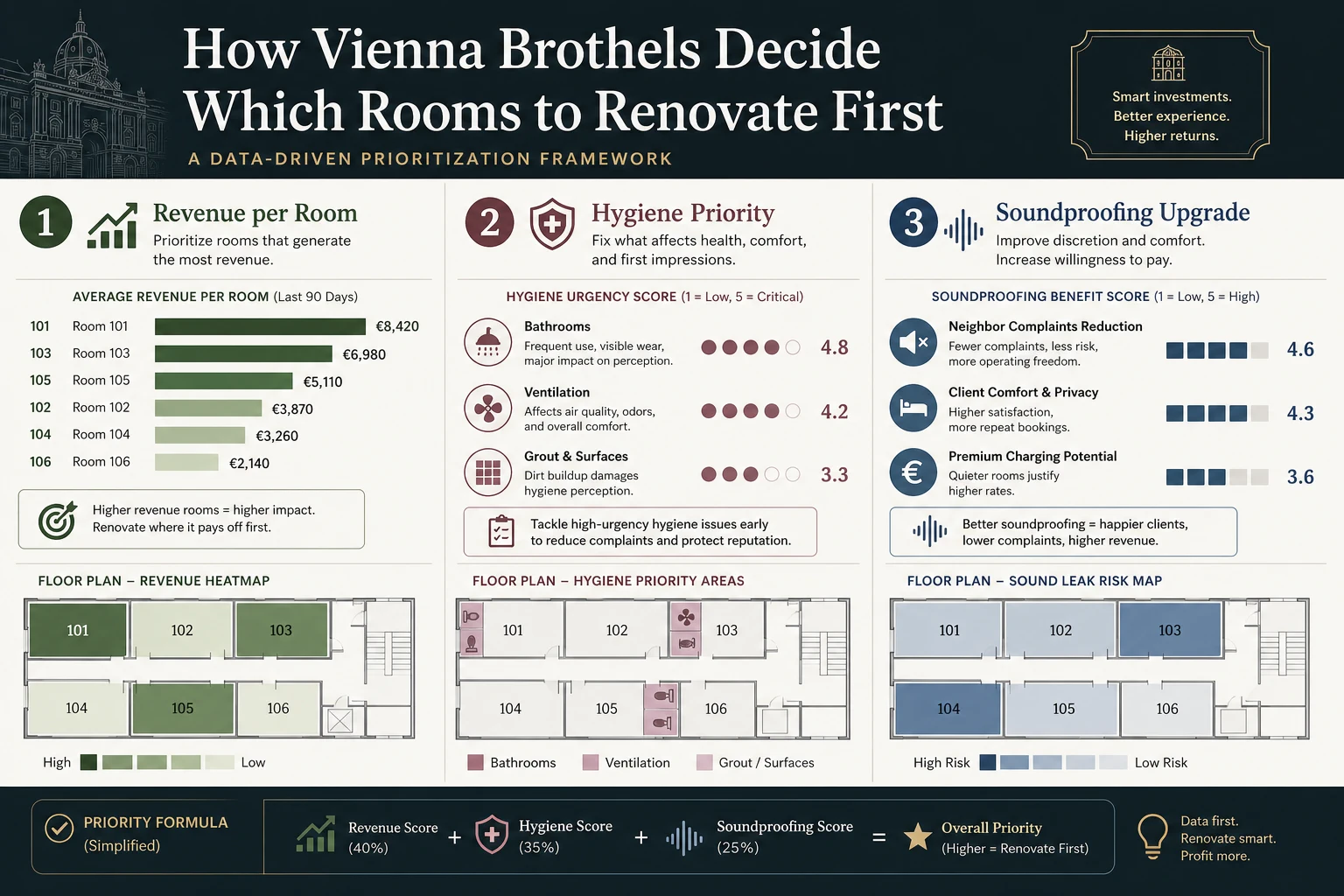
A house knows which rooms get booked and which get offered only when nothing else is free. That data is not sophisticated, it is just the booking record, and it sorts the rooms immediately. The instinct is to fix the worst performer first, and that instinct is often wrong: a weak room may be weak because of its location in the building, and no amount of new furniture moves a room next to a service door.
So the usual approach is to invest where the return is provable. Upgrading a room that is already popular into a premium category earns more than rescuing one nobody requests. The categories themselves are what make that arithmetic possible, and they are visible in any published tariff: one Vienna venue lists what a standard room and a VIP room each cost, and the gap between those two numbers is exactly the payback a refurbishment is chasing.
Anything involving hygiene jumps the queue
Bathrooms, ventilation, surfaces that cannot be cleaned properly, grout that has stopped being white: none of these wait for a budget cycle. They sit in a different category from decor because they touch standards that are inspected rather than admired, and because guests notice them before anything else in the room.
Experienced managers treat a failing bathroom as urgent maintenance, not renovation, which is a useful distinction: maintenance gets done now, renovation gets scheduled. The reasons behind the strictness are in why brothel hygiene is taken seriously in Austria and how hygiene works in Vienna brothels.
Soundproofing is the upgrade nobody photographs
It never appears in a gallery and it changes the experience more than any other single item. A room where the corridor is audible, or worse where the next room is, undermines the one thing a guest is paying for. Walls, doors and floor build-ups are expensive and invisible, which is precisely why cheaper operations skip them and keep buying mirrors instead.
You can hear the difference within a minute of the door closing, and it is one of the better tests of whether a house spends money on substance. It also explains why these rooms are not simply hotel rooms with different branding, a point we made in how brothel rooms differ from hotel rooms.
What guests ask for, and what staff report
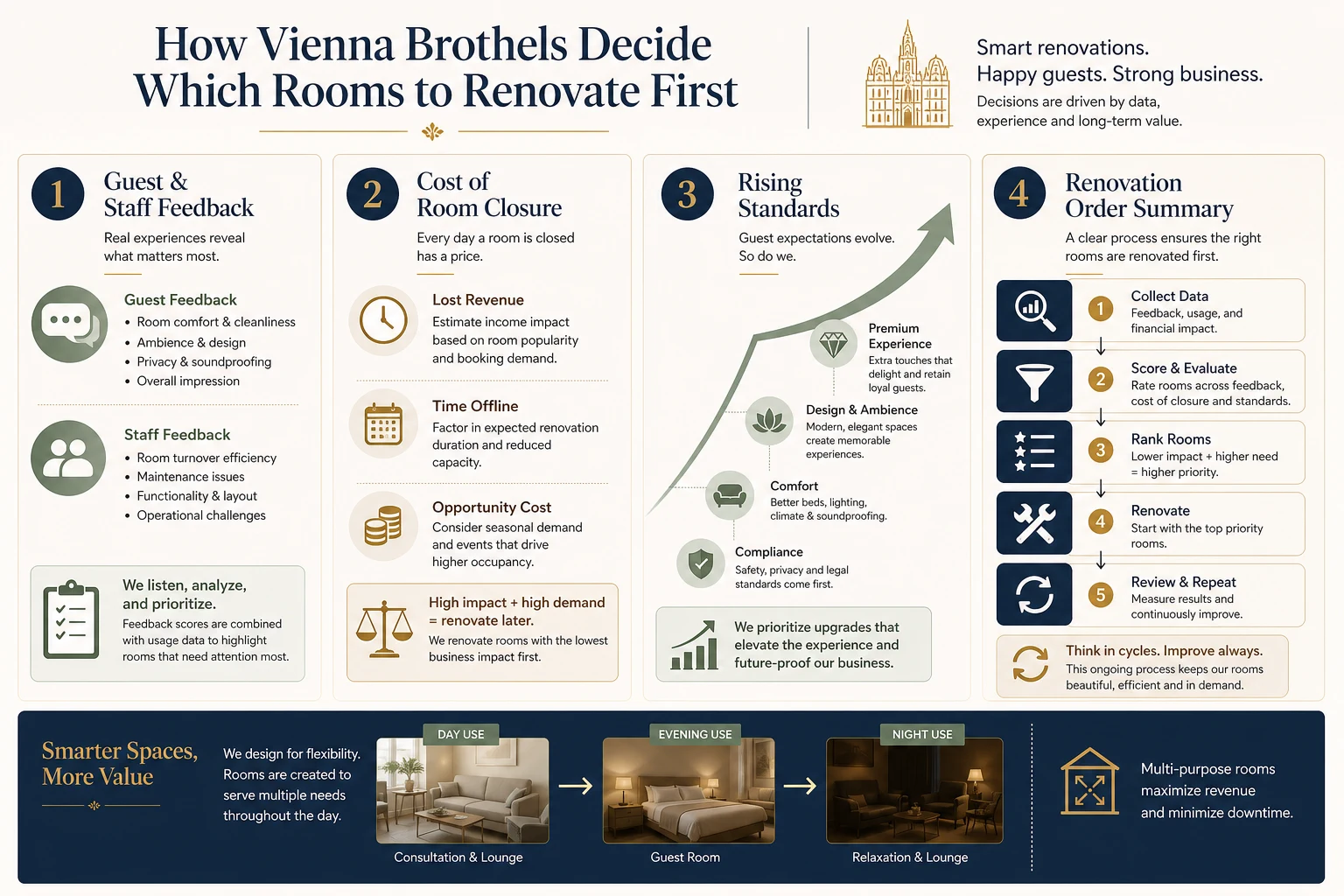
Two internal sources drive the list more than any consultant would. Guests ask for specific things at reception, repeatedly, and repetition is data. Housekeeping knows which room takes longest to reset, which shower drains slowly, which lamp has been rewired twice. Between them they produce a more accurate priority order than a walkthrough by an owner ever does.
Houses that ignore both are recognisable, because the same small irritations survive for years. Comfort is the cumulative result of listening to this, and we looked at why some venues feel better than others in why some brothels feel more comfortable than others.
The cost of the room being closed
A room under refurbishment earns nothing, and in a six-room house that is a significant share of capacity. This is why work happens one room at a time, in the quieter part of the year, and almost never in a week when the city is full. It is also why projects get split: a bathroom this quarter, the furniture next, rather than a single shutdown.
Midweek closures are less costly than weekend ones, which is the same demand pattern that drives the pricing, and we set that out in average prices in Viennese brothels.
There is a related decision that gets made at the same time and rarely gets discussed: whether a room should stay a room at all. A space that never performs, whatever is done to it, is sometimes worth more as something else. A poorly placed room becomes storage, a staff area, or the extra bathroom the floor has needed for years. Occasionally two small rooms become one large one, which loses a unit of capacity and gains a category that can be priced higher. Those conversions are the least visible work a house ever does, and they often improve the building more than a new bed in an awkward corner would.
Why standards keep rising
The baseline is not fixed. What counted as a good room fifteen years ago is unremarkable now, because guests compare against hotels and against photographs of other venues, and because the market for the top segment has become genuinely competitive. A house that stops investing does not stay where it was; it drifts downward relative to everybody else.
That drift is slow and then sudden, which is why the refurbishment order matters so much. The long arc of those changing expectations is described in how brothels have changed over the last 30 years.
The order, summarised
Hygiene and anything broken come first, because they are maintenance rather than renovation and because they are inspected. Soundproofing comes next, since it changes the experience most and shows least. Then the rooms with provable demand get upgraded into a higher category, because that is where the return is measurable. Rooms that underperform for structural reasons get repurposed rather than redecorated. And all of it happens one room at a time, midweek, in the quiet season, because a closed room earns nothing at all.