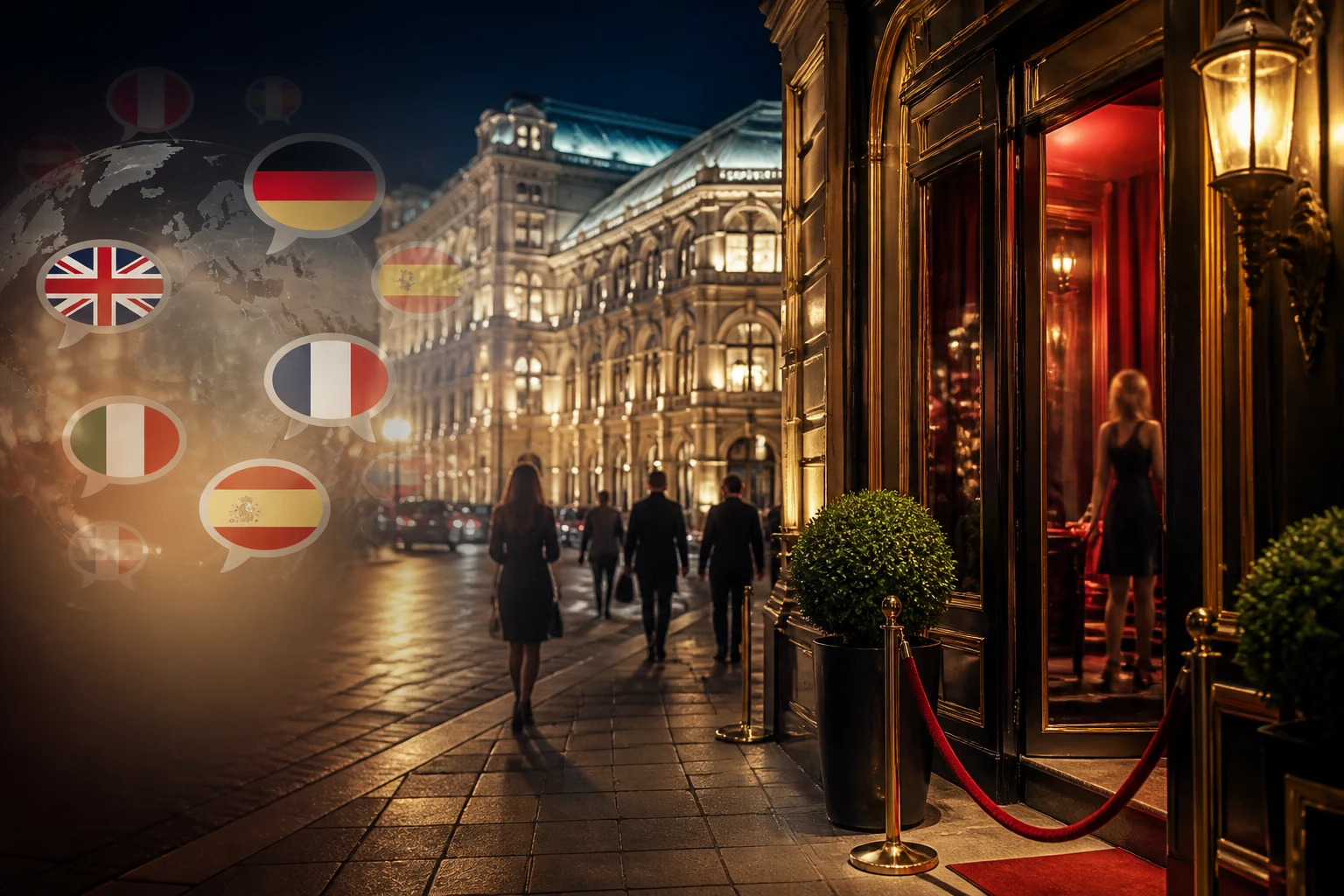
Vienna is a city where the waiter switches to English before you finish your first sentence, and the adult venues are no different. Language is one of the most common worries for a first-time visitor from abroad, and it is also one of the least justified. The practical answer is that you will be understood, and the interesting question is why.
German is the setting, not the requirement
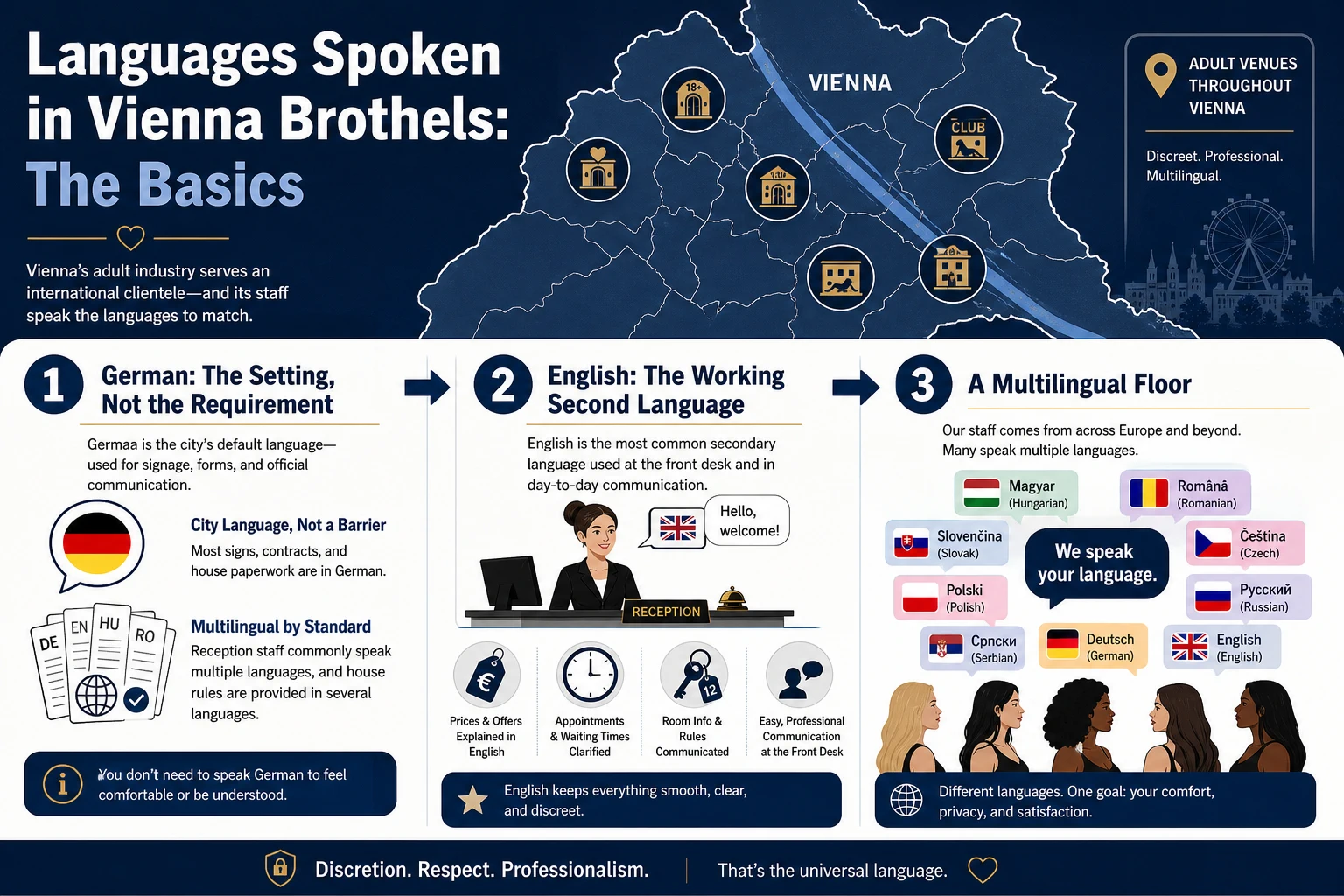
German is the working language of the city and the language most signage and paperwork uses. Inside a venue, though, it is the default rather than the condition of entry. Reception staff switch languages constantly, and house rules in the larger places are often posted in more than one language precisely because the audience is international.
What this means in practice is that not speaking German costs you nothing at the door. It may cost you a little nuance later in the evening, which is a different and smaller problem.
There is one more reason the language mix runs deeper than it looks from outside. Reception in a busy house is a job of matching rather than greeting: somebody arrives, says four sentences, and the person behind the desk is already working out who on the floor tonight will make that conversation easy. Language is one of the inputs into that decision, alongside timing, room availability and what the guest has actually asked for. It is rarely stated out loud, which is why visitors tend to assume it is luck when the woman who comes over turns out to share their language. It is usually not luck. It is somebody doing their job well, and it is one of the clearest differences between a professional house and an improvised one.
English is the working second language
English is spoken widely and confidently, especially by staff whose job is the front of the house. Prices, room types, timing and rules are all conversations the reception has had thousands of times in English, so they are efficient rather than hesitant. This is the part that surprises visitors who expect to be struggling with a phrasebook.
The neighbouring venue types work the same way, which is worth knowing if your evening involves more than one stop. Two useful reads on exactly this: using English in Vienna’s high-class sex clubs and, for the bar format, visiting a Vienna sex bar with only English.
Why the floor is genuinely multilingual
The women working in Vienna come from across Central and Eastern Europe as well as Austria, and they bring their languages with them. Hungarian, Romanian, Slovak, Czech, Polish, Russian and Serbian are all heard regularly, alongside German and English. On a busy evening a larger house can cover a remarkable spread without anyone planning it.
This is a direct consequence of who works here, a subject we looked at in what kind of women work in Viennese brothels and, for one of the larger groups specifically, in Romanian sex workers in Vienna.
Asking for a language is normal
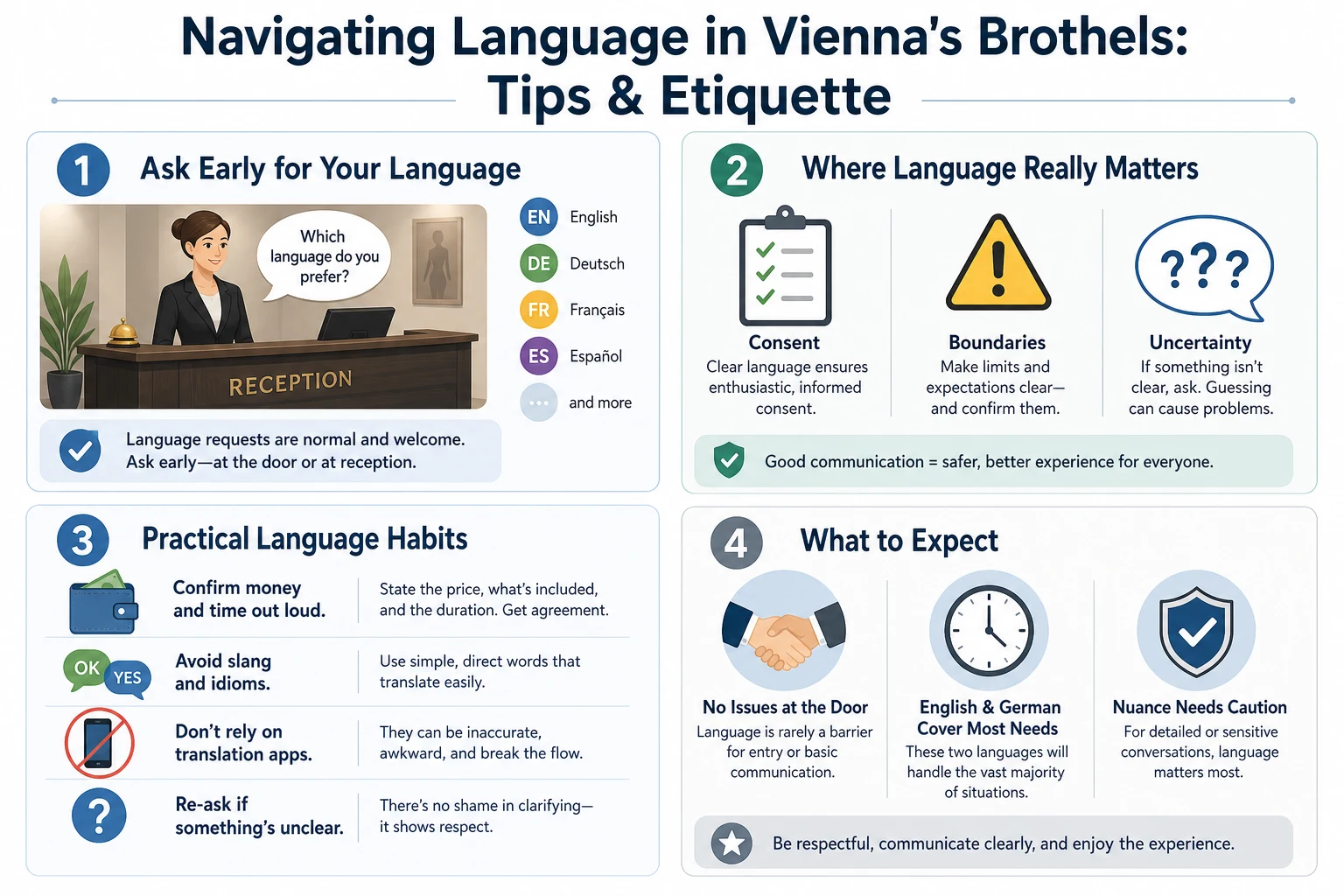
If a shared language matters to you, say so at reception. It is an ordinary request, handled in the same breath as a question about room types, and nobody finds it odd. In a house with a dozen women present, reception knows who speaks what better than any profile page does.
It is also a request worth making early rather than after you have already chosen, because the point of asking is to widen the shortlist, not to narrow it. Choosing at all is a process with its own etiquette, and we described it in choosing specific girls in Vienna brothels.
Where language actually matters
Here is the honest part. For prices, timing and rules, a shared vocabulary of thirty words is plenty, and mistakes are unlikely because both sides are motivated to be clear. For consent, boundaries and what is and is not on offer, fluency matters much more, because those conversations rely on tone and qualification rather than nouns.
So the rule is: if you are not confident you would catch a hesitation, slow down. Ask again, ask plainly, and treat anything ambiguous as a no. That principle does not change with language, and it is the subject of why no really means no in Viennese brothels.
Practical habits for a visit in a second language
Settle the money and the time in English at reception, before anything else, and repeat the numbers back. Write nothing down but confirm out loud. Avoid slang and idioms, including the ones you think are universal, because they are the first thing to break. And do not rely on a translation app mid-conversation: it is slow, it kills the mood, and it mistranslates exactly the words that matter most.
One more, which sounds obvious and is often ignored: if something feels unclear, stop and re-ask rather than proceeding on an assumption. Nobody in a professional house will be annoyed by a second question.
What to expect
You will not have a language problem at the door in Vienna. German is the setting, English is the working second language, and the floor of a larger house covers much of Central and Eastern Europe without being asked. Say at reception if a shared language matters, and say it early. Keep the money and the timing conversation short, explicit and repeated back. And reserve your caution for the conversations about boundaries, where a missed nuance costs something real, rather than for the ones about prices, where it does not.