
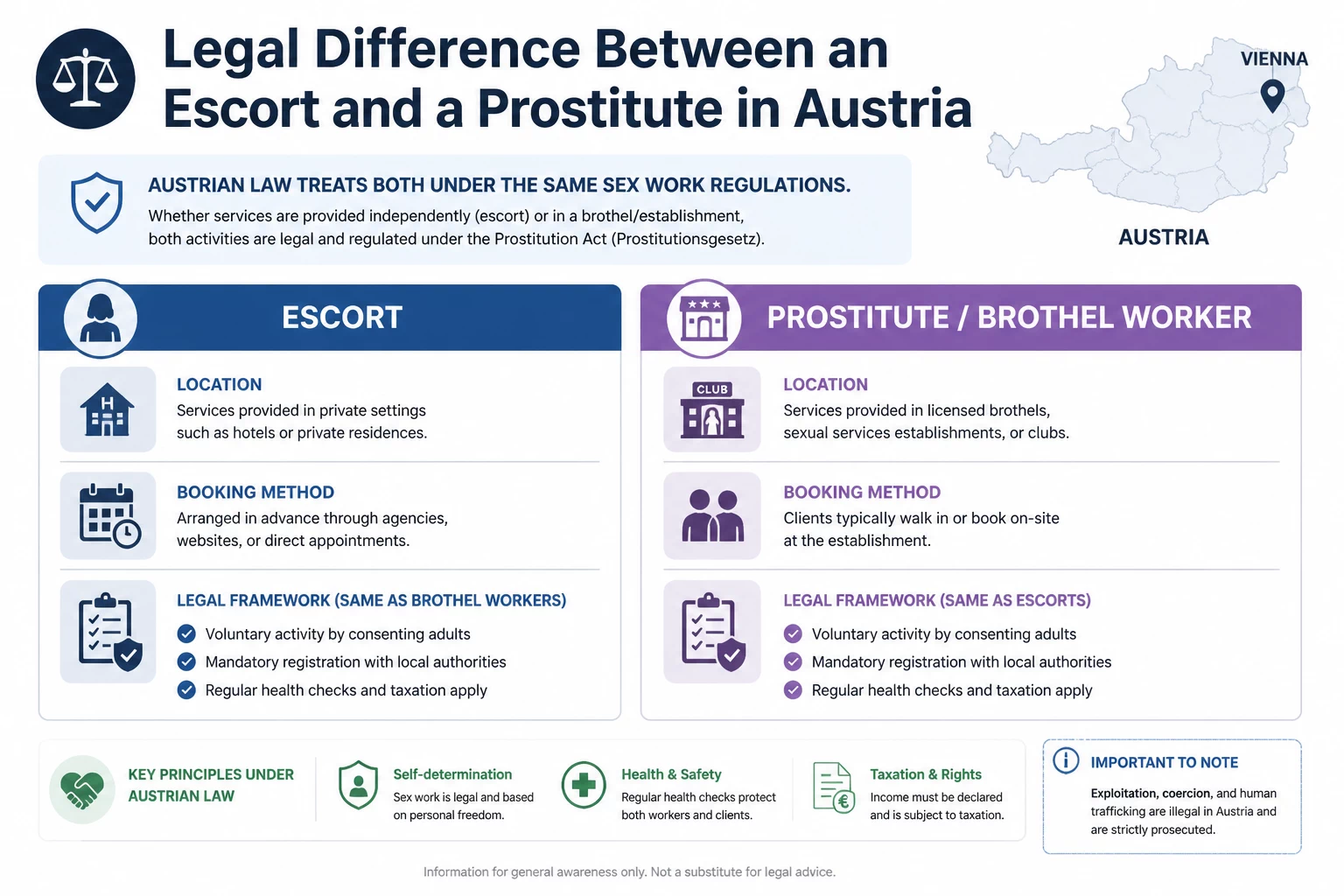
In Austria, “escort” and “prostitute” are not two separate legal professions. The law is concerned with the provision of sexual services for payment, not with the more polished or traditional language used in advertising. An escort may meet a client in a hotel or private residence, while another sex worker may receive clients in a licensed venue, but both fall within the legal framework for sex work.
The real difference is usually practical and commercial. Escort work tends to be arranged by appointment, often through an agency or independent booking channel. Brothel and club work normally takes place at a fixed house, where the women meet visitors on site. Registration, health requirements, taxation, consent and personal rights remain relevant in both settings.

What Austrian law actually sees
Austrian law generally treats paid sexual services as sex work, regardless of whether the person is described as an escort, prostitute, companion or independent provider. “Escort” is mainly a commercial label. It often suggests discretion, a social element or travel to the client, but the word itself does not create a separate legal category with a different set of basic rights.
The same point applies to the word “prostitute”, although many people now prefer “sex worker” because it describes the occupation without reducing the person to it. A legal assessment depends on the activity, the location, the local rules and the way the business operates. Vienna’s official information on prostitution in the city is a useful starting point for the local framework.
Registration and health rules
Legal sex work is not simply a private arrangement with no administrative obligations. Sex workers must meet the applicable registration and documentation requirements, which can include proof of identity, residence or work entitlement and registration with the competent authority. The details depend on the federal state and the circumstances of the work, so a person working through an agency and a person working in a house may have different practical paperwork even though both are in sex work.
Health checks are also part of the Austrian system for sex workers. They are not an “escort rule” or a “brothel rule”. The applicable examinations and certificates concern the lawful provision of sexual services, with procedures administered under public health arrangements. For a clearer explanation of the purpose and practical side of these examinations, see this guide to health checks in Austrian brothels. Registration and checks do not remove the need for consent, safer-sex discussions or personal boundaries.
Where the meeting happens
The most visible practical distinction is location. An escort commonly travels to a hotel, home or another agreed place, known as an outcall. Some escorts also receive clients privately, subject to the applicable local rules. The appointment is normally arranged in advance, and the client may communicate with the sex worker directly or through an agency.
In a brothel, club, studio or Laufhaus, the client visits the venue. The women are present during the house’s operating period, and the first conversation often takes place in a lounge, bar or corridor rather than through a long pre-booking process. Each format has its own atmosphere and etiquette. This comparison of a Laufhaus, studio and sex club explains why the labels matter commercially, even though none of them creates a separate legal status from escort work.
Agency, house and independence
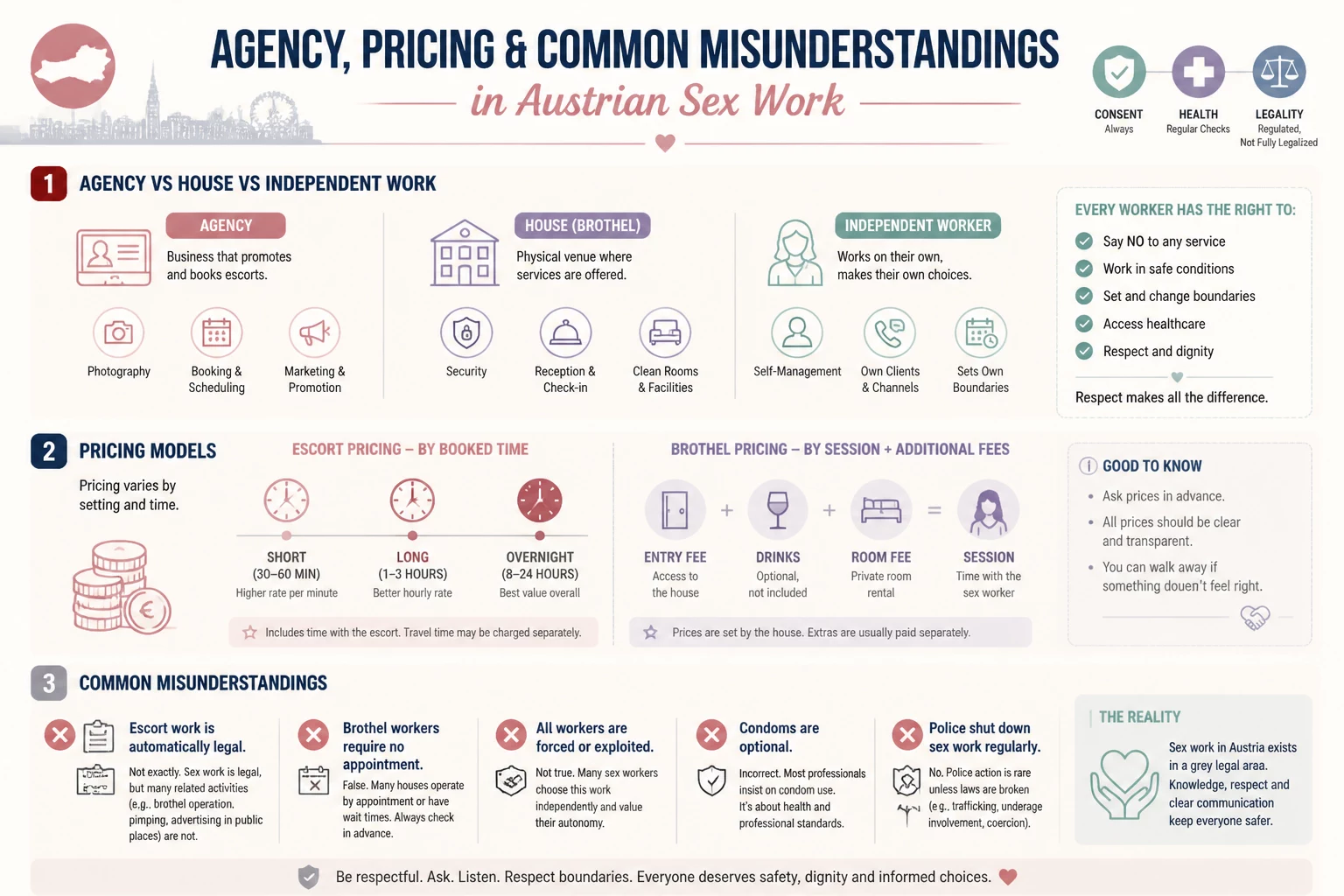
An escort may work independently or be introduced through an agency. An agency can handle advertising, photographs, enquiries, diary management and transport arrangements. The sex worker still provides the service, sets or agrees boundaries and should be treated as the person whose consent controls the meeting. Agency branding can make the service feel more formal, but it does not by itself prove that the business is licensed or that every advertised arrangement is lawful.
A house has a different operating model. It provides premises, reception, security, cleaning and promotion, while the women work there under the venue’s arrangements. The client usually pays according to the house’s system, which may involve a room charge, a service payment, drinks or other clearly stated costs. Some venues operate with considerable independence for the women; others organise the evening more centrally. Details vary by house and should be checked before committing money.
How pricing and time work
Escort pricing is commonly built around booked time. A listing may describe a meeting of a certain duration, with different rates for a short appointment, a longer visit, travel, an evening or an overnight booking. The price may also reflect the agency’s commission, the woman’s profile, the location and the amount of planning involved. Descriptions such as premium or luxury are marketing terms rather than legal grades. This explanation of premium and regular escort services shows how those distinctions are normally used.
At a venue, the conversation is more often framed as a session. The house may display a basic period or minimum, while additional time is agreed with the woman. The venue can also have entry fees, table charges, drinks or room costs, depending on its model. A visitor should ask what is included before the meeting begins, keep payment discreet and avoid assuming that a general house price covers every separate item. Licensed high-class venues such as Maxim Wien publish their own commercial information, illustrating why pricing should be read as a venue policy, not as a legal definition of escort work.
Common misunderstandings
The first misconception is that escort work is automatically legal while prostitution in a brothel is automatically illegal, or the reverse. Neither assumption is sound. Legality depends on compliance with the relevant rules, including the place of work and administrative requirements. A private hotel meeting is not made lawful simply by calling it escorting, and a venue is not made unlawful simply because it offers sexual services.
Another misconception is that an escort must provide companionship beyond sexual services, or that a woman in a brothel is available without an appointment or personal negotiation. Both ideas ignore consent and working arrangements. A meeting can include conversation, dinner or social time, but the agreed service and its boundaries remain personal. A client is buying an agreed appointment or session, never unrestricted access to a person. For a wider look at the different commercial models, this guide to brothels and escort services is a useful companion read.
The practical answer
In Austrian law, escort and prostitute are not opposing legal categories. Both describe people who may be performing sex work, and both can be subject to registration, health checks, tax obligations and local operating rules. The meaningful differences concern the setting, the booking route, the role of an agency or venue and the way time and costs are presented.
For clients, the sensible approach is straightforward: use a lawful venue or reputable booking channel, clarify the total cost and duration before meeting, respect the woman’s boundaries and treat health requirements as part of the professional framework. The label in an advert is less important than the actual arrangement behind it.