
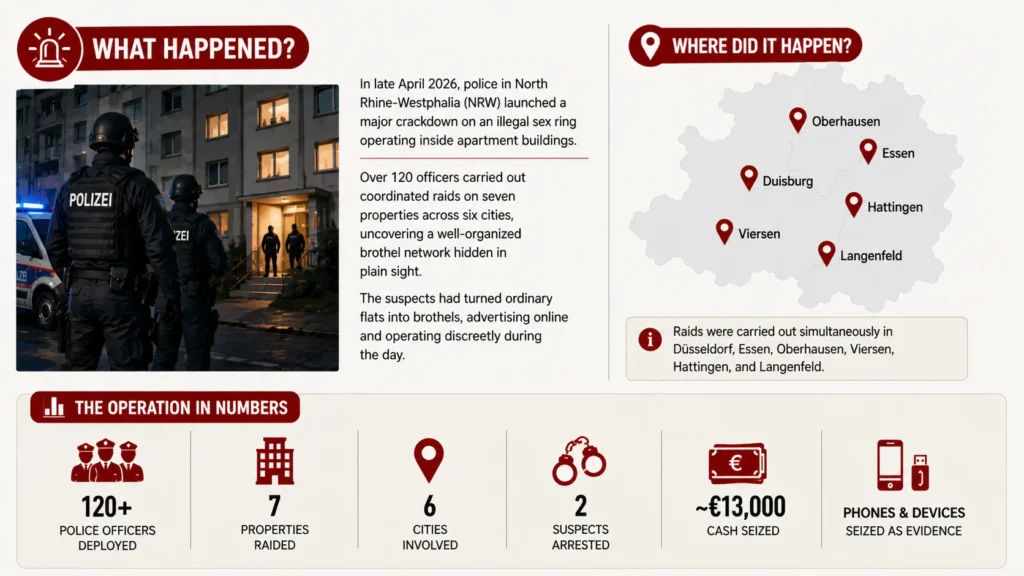
In late April 2026, police in North Rhine-Westphalia (NRW) carried out one of their biggest crackdowns on illegal prostitution in recent memory. Over 120 officers fanned out across six cities in a single coordinated operation, targeting a criminal network that had been hiding a brothel operation inside everyday apartment buildings — right under the noses of neighbors and landlords.

A Sex Ring Built on Secrecy
What made this operation unusual was how well the suspects had concealed what they were doing. Instead of running a visible, registered brothel, the group rented ordinary apartments and quietly turned them into working locations for sex workers. The flats looked completely normal from the outside. Ads were posted on adult websites, clients came and went during the day, and by evening the apartments looked like any other residence in the building.
This kind of setup is sometimes called a “day-use apartment,” and it’s becoming a growing problem for law enforcement across Germany. Because these locations blend into residential neighborhoods, they’re far harder to detect and regulate than a traditional licensed brothel.
The Prostitution Raids: Six Cities, Seven Properties
On the day of the operation, officers moved simultaneously on seven properties spread across Düsseldorf, Essen, Oberhausen, Viersen, Hattingen, and Langenfeld. Specialized units were brought in, including dogs trained to sniff out hidden cash.
Two suspects were arrested on the spot under pre-existing warrants. Both were taken before a judge and remanded into custody. Three women found at the locations — all in Germany without legal status and working as prostitutes — were handed over to immigration authorities.
When the searches were finished, police had seized roughly €13,000 in cash, along with multiple mobile phones and digital storage devices that investigators will now comb through for evidence.
Who Was Running the Illegal Sex Operation
The case is being handled by prosecutors in Düsseldorf. Four suspects are at the center of the investigation: three Chinese women and one Chinese man, ranging in age from 42 to 59. According to investigators, the group organized the entire operation — renting the apartments, posting the online ads, managing the sex workers, and collecting the money.
The charges being examined are serious. They include running an illegal brothel, smuggling foreign nationals into Germany, and employing people who had no legal right to work in the country. Together, these offenses point to a well-organized criminal enterprise rather than a small-scale informal arrangement.
Why Illegal Brothels Are a Bigger Problem Than They Look
Germany has one of the most regulated prostitution industries in Europe. Licensed brothels must meet strict health, safety, and employment standards. Sex workers are required to register, pay taxes, and have access to legal protections.
Illegal brothel operations undermine all of that. When prostitution is pushed into unregulated apartments, sex workers lose any legal protection they might otherwise have. Many are vulnerable to exploitation and have no way to report abuse or unsafe conditions without risking deportation. The money generated flows into criminal networks rather than the legal economy.
This particular case also involved human smuggling — meaning some of the women may have been brought to Germany specifically to work in these conditions, with little or no freedom to leave.
What Sex Clients Don’t Always Think About
Many people who visit an illegal brothel assume the risk is low because they’re just a client. That assumption is worth reconsidering.
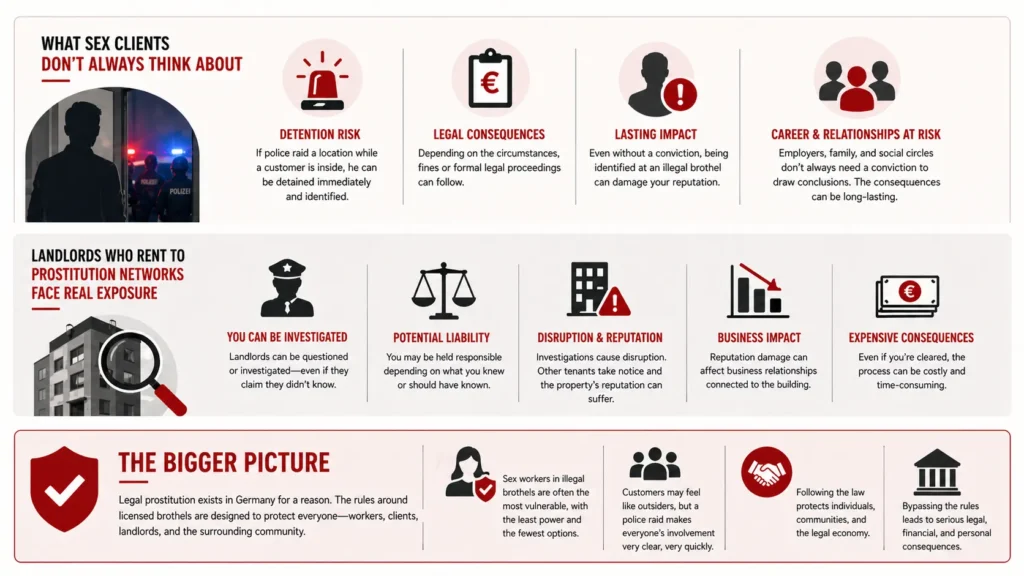
If police raid a location while a customer is inside, he can be detained immediately, identified, and drawn into a criminal investigation. Depending on the circumstances, fines or formal legal proceedings can follow. But even if no charges are ever filed, the experience itself — being caught inside an illegal brothel during a police raid — can have lasting consequences.
Employers, family members, and social circles don’t always need a conviction to draw conclusions. The simple fact of being identified at that kind of location can be enough to damage a career or a relationship in ways that are very difficult to undo.
Landlords Who Rent to Prostitution Networks Face Real Exposure Too
Property owners often assume they’re protected as long as they didn’t know what was going on in their apartments. The reality is more complicated.
When a flat becomes the focus of a police investigation into illegal prostitution, the landlord can still be pulled into the process — questioned, investigated, and in some cases held responsible depending on what they knew or should have known. Even if they’re ultimately cleared, the investigation itself causes disruption. Other tenants in the building take notice. The property’s reputation can suffer. In some cases, business relationships tied to the building are affected as well.
Renting to someone running an illegal brothel, even unknowingly, can turn into a serious and expensive problem.
The Takeaway: Legal Sex Work Exists for Good Reason
The NRW operation is a good example of how seriously German authorities treat illegal prostitution — and how wide the net can stretch when they do act. The people running the brothel face the most serious consequences, but the risks don’t stop with them.
Sex workers in these situations are often the most vulnerable people involved, with the least power and the fewest options. Customers and landlords may feel like outsiders to the operation, but a police raid has a way of making everyone’s involvement very clear, very quickly.
Legal prostitution exists in Germany for a reason. The rules around licensed brothels are designed to protect everyone — workers, clients, and the surrounding community. When those rules are bypassed, the fallout tends to reach much further than most people expect.